

OBD-II Code P0008: Engine Position System Performance Bank 1
The Ultimate Guide to P0008: Meaning, Causes, and Fixes
- Code P0008 indicates a critical mechanical timing misalignment on engine Bank 1, often triggered when the camshaft and crankshaft deviate by just 4 to 5 degrees.
- A stretched timing chain causes over 80% of P0008 codes, particularly in 2007-2017 General Motors 3.6L V6 engines.
- Stop driving immediately; continuing to drive risks the timing chain jumping teeth, leading to a $7,000 to $12,000 complete engine replacement.
- Expect repair costs between $2,800 and $5,000 for a full timing chain replacement, but demand a $150-$300 oscilloscope diagnostic first to rule out cheaper sensor or oil pressure issues.
What Does P0008 Mean?
The Engine Control Module (ECM) detects a mechanical timing failure. The rotational position of the crankshaft and the Bank 1 camshafts (the side with cylinder #1) are out of sync. This precise synchronization is mandatory for engine operation.
Technical definition: The SAE/OBD-II definition is "Engine Position System Performance Bank 1." The ECM determines that the mechanical timing between the crankshaft and the Bank 1 camshafts deviates beyond a programmed threshold 🎬 Watch: A detailed breakdown of how the ECM detects timing errors. (typically 4-5 degrees) for a set duration. The ECM calculates this by continuously comparing signals from the crankshaft position sensor (CKP) and Bank 1 camshaft position sensors (CMP).
Can I Drive With P0008?
No — Do Not Drive. Do not drive the vehicle. P0008 indicates a critical mechanical timing failure. Continuing to drive guarantees the timing chain will jump teeth or break entirely. This causes pistons to collide with valves, resulting in catastrophic, non-repairable engine damage. A complete engine replacement costs $7,000-$12,000+, far exceeding the cost of a prompt timing repair.
Common Causes
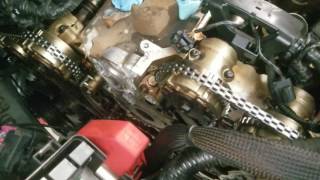
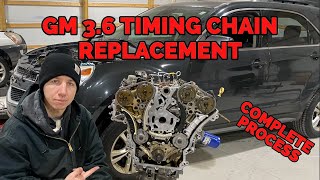
- Stretched or worn timing chain(s) (Very Common) — Metal timing chains physically stretch over time. This introduces slack that tensioners cannot compensate for, permanently throwing the camshafts and crankshaft out of sync. This is the definitive trigger for P0008, especially in GM 3.6L V6 engines. 🎬 Watch: Full step-by-step timing chain replacement for GM 3.6L engines.
- Low, dirty, or incorrect viscosity engine oil (Common) — Hydraulic tensioners and VVT solenoids require clean oil at exact pressures. Low oil, sludge, a clogged filter, or the wrong viscosity (e.g., 5W-30 instead of 5W-20) starves these components, creating chain slack and timing errors.
- Worn or failing timing chain tensioners and guides (Common) — Tensioners keep timing chains tight. A blown tensioner seal or a shattered plastic guide leaves the chain loose, causing immediate timing deviations and audible rattling.
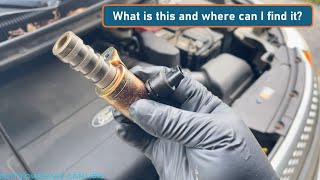
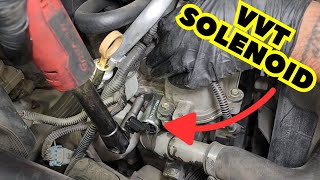
- Failing Variable Valve Timing (VVT) solenoid or actuator (Less Common) — The VVT system adjusts camshaft timing dynamically. A clogged VVT solenoid (oil control valve) or a stuck VVT actuator (phaser) locks a camshaft in the wrong position, triggering the code.
- Failing camshaft or crankshaft position sensor (Less Common) — These sensors report rotational positions to the ECM. A failing sensor sends erratic data, tricking the ECM into diagnosing a mechanical timing problem that does not exist.
- Slipped crankshaft reluctor wheel (Rare) — The reluctor wheel is a toothed ring on the crankshaft read by the position sensor. In specific engines (like early GM V6s), this wheel slips out of alignment, creating a permanent discrepancy between actual and reported crankshaft position.
- Damaged wiring or poor electrical connections (Rare) — Corrosion in sensor connectors ('fretting') or melted wiring harnesses create weak signals, fooling the ECM into logging a timing correlation error.
- Faulty Engine Control Module (ECM) software (Rare) — The ECM software calibration is sometimes too sensitive. A dealer re-flash updates the acceptable timing deviation thresholds, resolving false codes.
Symptoms
- Check Engine Light is on — The MIL illuminates steadily. In early stages of chain stretch, this is the only visible symptom.
- Rough idle, poor acceleration, and hard starting — The engine shakes at a stop, lacks power during acceleration, and struggles to start. Severe timing misalignment directly degrades combustion efficiency.
- Rattling noise from the engine — A loose timing chain slaps against its metal or plastic guides, creating a distinct clattering sound most prominent during cold starts.
- Decreased fuel economy — Incorrect valve timing forces the engine to burn fuel inefficiently, dropping fuel economy by 10-20%.
Diagnostic Flowchart
Tap your situation to follow the diagnostic path that matches what you're seeing on this code.
Common Fixes & Costs
- Timing Chain and Component Replacement — Parts: $500-$1200, Labor: $2250-$3800, ~16.0 hr book time (Professional)
- Variable Valve Timing (VVT) Solenoid Replacement — Parts: $50-$200, Labor: $100-$250, ~1.0 hr book time (DIY)
- Camshaft Position Sensor Replacement — Parts: $50-$150, Labor: $100-$250, ~1.5 hr book time (DIY)
- Crankshaft Position Sensor Replacement — Parts: $50-$150, Labor: $150-$700, ~2.0 hr book time (Intermediate)
- ECM Reprogramming or Replacement — Parts: $0-$1200, Labor: $100-$300, ~1.5 hr book time (Professional)
Used vs. New Parts: Buying Guide
When a used part is worth it: NEVER. Timing chains fail due to physical wear and stretching. Installing a used chain guarantees premature failure and forces you to pay the $2,500+ labor cost twice.
Donor quality checklist:
- Buy only NEW, updated OEM kits or premium aftermarket kits (Cloyes, Melling, INA).
- Avoid unbranded 'white box' kits from Amazon/eBay; their cheap metals stretch within 10,000 miles.
- Verify the kit matches your exact engine RPO code (e.g., GM LLT vs. LFX).
Decision logic:
- If You plan to keep the vehicle for more than 1 year. → Buy a new OEM kit or a premium aftermarket kit from a known OE supplier.
- If Replacing a sensor as a diagnostic step. → Buy a new OEM or top-tier aftermarket sensor (Bosch, NTK). Used sensors provide unreliable data.
Warranty tradeoff: New Aftermarket Parts: 1-year to limited lifetime warranty. New OEM Parts: 12-month/12,000-mile warranty. Used Parts: No warranty covers the massive labor cost of a second failure.
Worst-case if a used part fails: $4,500. If a cheap timing kit fails, you pay the full price of the 15-hour labor job again, plus a new kit.
What Happens If You Wait — Timeline
- 0-1 month: Code P0008 sets. The Check Engine Light illuminates. The timing deviation is minimal (4-5 degrees). No noticeable drivability symptoms exist yet. (MPG impact: 0-5%% · Added cost: $0)
- 1-4 months: Chain stretch increases. The engine develops a rough idle, hesitates on acceleration, and rattles briefly on cold starts. (MPG impact: 5-15%% · Added cost: $50-$150 in wasted fuel.)
- 4-6 months: Timing deviates by several degrees. The loose chain slaps guides continuously. Misfires occur. Unburnt fuel dumps into the exhaust, overheating the catalytic converter. (MPG impact: 15-25%% · Added cost: $1,200-$2,800 for catalytic converter replacement.)
- Any time, but highly likely after 6+ months: The timing chain jumps teeth or snaps. Pistons smash into open valves. The engine stalls violently with loud grinding noises and will not restart. (MPG impact: 100% (vehicle is inoperable)% · Added cost: $7,000-$12,000+ for complete engine replacement.)
Cost of Not Fixing It
- Immediate (0-1 month): Fuel economy drops 10-20%. The engine hesitates and idles roughly. The vehicle automatically fails state emissions inspections. (Added cost: $20-$60 per month in wasted fuel.)
- Short Term (1-3 months): Misfires dump raw fuel into the exhaust, melting the internal honeycomb of the catalytic converter. (Added cost: $1,200-$2,800 for catalytic converter replacement.)
- Long Term (3+ months or any time): The timing chain jumps teeth or breaks. Pistons collide with valves, destroying the engine block and cylinder heads. (Added cost: $7,000-$12,000+ for a complete engine replacement.)
Diagnosis Steps
- Check Engine Oil Level, Condition, and Type
Low, dirty, or incorrect oil causes timing issues. Pull the dipstick to verify the level is full and the oil is clean. Confirm the correct viscosity was used at the last change.
Tools: Rag or paper towel (Beginner) - Scan for Other Trouble Codes
Read all codes. P0008 rarely appears alone. Codes P0016 or P0017 isolate the issue to specific camshafts. Record freeze-frame data to see engine conditions when the fault occurred.
Tools: OBD-II Scanner (Beginner) - Visually Inspect Wiring and Sensors
Inspect the camshaft and crankshaft position sensors. Look for frayed wires, melted harnesses, or oil contamination. Unplug connectors and check for green corrosion (fretting) on the pins.
Tools: Flashlight (Intermediate) - Test VVT Solenoid Resistance
Disconnect the VVT solenoid connectors. Set a multimeter to Ohms (Ω). A healthy GM VVT solenoid reads 8-13 Ohms. A reading of infinity (OL) means an open circuit; near zero means a short. Replace the solenoid if it fails this test.
Tools: Digital Multimeter, Socket set (Advanced) - Test Oil Pressure
Connect a mechanical gauge to the engine oil pressure port. A GM 3.6L V6 requires a minimum of 20-30 PSI at hot idle. Low pressure proves the timing components are starved of hydraulics, pointing to a failing oil pump or severe sludge.
Tools: Mechanical oil pressure gauge set, vehicle-specific adapter (Advanced) - Advanced Scan Tool Analysis (Camshaft PIDs)
Use a bi-directional scanner to monitor 'Desired' vs. 'Actual' camshaft positions. Command the cam phaser to advance. If the 'Actual' value lags significantly or doesn't move, the phaser is stuck or the chain is stretched.
Tools: Bi-directional scan tool (Advanced) - Definitive Diagnosis with an Oscilloscope
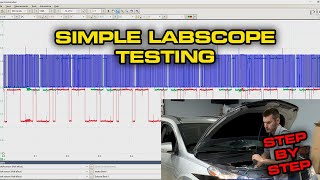
Connect a lab scope to the crankshaft sensor and Bank 1 camshaft sensors. Compare the live waveforms to a known-good pattern. If the camshaft signal lags behind the crankshaft signal, a stretched chain is definitively confirmed.
Tools: Oscilloscope, vehicle-specific wiring diagrams (Professional) - Inspect Internal Timing Components
Remove the engine's timing cover to physically inspect the chains, guides, and tensioners. Look for excessive slack between sprockets or broken plastic guide pieces.
Tools: Extensive mechanic's tool set (Professional)
When This Code Triggers (Freeze-Frame Conditions)
- Engine Coolant Temp: 180-210°F (82-99°C) (The engine is at full operating temperature. The diagnostic monitor runs after the engine warms up.)
- Engine RPM: 1200-3000 RPM (The code sets during steady-state cruising or light acceleration, rarely at idle or heavy throttle.)
- Engine Load: 20-50% (Moderate engine load is present, consistent with normal driving conditions.)
- Vehicle Speed: 30-60 mph (48-97 kph) (Occurs at city or highway cruising speeds where the ECM performs stable correlation checks.)
Related Codes
- P0009 — The identical timing correlation code for Bank 2. Seeing P0008 and P0009 together proves the fault affects both banks, pointing directly to a stretched primary timing chain or a slipped crankshaft reluctor wheel.
- P0016 — Crankshaft Position - Camshaft Position Correlation (Bank 1 Sensor A). Isolates the timing error to the Bank 1 intake camshaft. P0008 and P0016 together confirm a mechanical fault on Bank 1.
- P0017 — Crankshaft Position - Camshaft Position Correlation (Bank 1 Sensor B). Isolates the error to the Bank 1 exhaust camshaft. Seeing P0008, P0016, and P0017 together guarantees a stretched secondary timing chain on Bank 1.
- P0018 & P0019 — The Bank 2 equivalents of P0016 and P0017. They accompany P0009.
Climate & Environmental Factors
- Cold Weather: Cold temperatures thicken engine oil. This slows oil flow to hydraulic tensioners on startup. If a chain is already stretched, this sluggish hydraulic response creates a momentary timing misalignment that sets the code.
- High Temperatures / Severe Use: Towing or consistent high-heat operation accelerates oil degradation. Sludgy oil clogs VVT solenoid screens and blocks narrow passages, starving the timing system of pressure.
How to Talk to a Mechanic About This Code
Say this: "I have a P0008 code and need a diagnostic appointment. I authorize one hour of diagnostic time. Please verify oil pressure and test the cam and crank sensors with an oscilloscope before quoting a timing chain replacement."
This proves you are an informed customer. It forces the mechanic to follow a logical diagnostic path and caps your initial financial commitment.
Avoid saying:
- 'My check engine light is on, can you just fix it?'
- 'My car is rattling, I need a new timing chain.' (Never diagnose it for them)
- 'Just do whatever it takes to get the light off.'
Questions to ask before authorizing the repair:
- What was the exact oil pressure reading at hot idle?
- Did you use an oscilloscope to compare cam and crank signals? Can I see the waveform?
- Does the estimate include replacing all chains, tensioners, guides, and VVT sprockets?
- What is the warranty on the parts and labor?
Where to Take It: Dealer vs Independent vs Chain
- Dealer:
Best for: Vehicles under powertrain warranty or special coverage adjustments., Complex, manufacturer-specific issues (e.g., slipped reluctor wheel on GM, VANOS on BMW).
Downsides: Highest labor rates ($180-$250+/hr)., Often default to the most expensive repair (full timing kit) without exploring minor fixes. (Typical cost: +40% vs. baseline) - Independent Shop:
The best choice. A reputable independent shop with engine specialists provides dealer-level expertise at a significantly lower labor rate. Ensure they have experience with timing chains on your specific engine.
Best for: Out-of-warranty vehicles requiring major engine work., Getting a second opinion on a dealer's $4,000+ quote.
Downsides: Expertise varies. You must verify they have ASE-certified engine specialists. (Typical cost: +0% vs. baseline) - Chain Shop:
AVOID. P0008 is a severe engine problem. Quick-lube chain shops will misdiagnose this code or botch the complex repair.
Best for: Routine oil changes and tire rotations.
Downsides: Technicians lack the training for complex internal engine diagnostics., Do not possess the specialized cam-locking tools required for timing jobs. (Typical cost: -10% vs. baseline)
When to Walk Away From the Repair
If the $3,000-$5,000 timing chain repair exceeds 50% of your car's private-party Kelley Blue Book value, sell or trade in the vehicle.
- Car worth $6000, fix is $3500: Walk away. The repair is nearly 60% of the car's value. Sell it 'as-is' to a private party or CarMax.
- Car worth $15000, fix is $3800: Fix it. The repair is 25% of the value and restores the vehicle's primary function.
- Car worth $3500, fix is $3200: Walk away immediately. The repair equals the value of the car.
What Scan Tool You Need for This Code
Minimum: A scanner that graphs live data PIDs for crankshaft and camshaft positions.
A $20 code reader only displays 'P0008'. You need live sensor data to see the exact degree of deviation between the cams and crank to determine if the fault is mechanical or electrical.
Budget: BlueDriver Pro (~$100) — Connects via Bluetooth. Graphs live data from cam and crank sensors to spot discrepancies. Provides access to a database of verified fixes.
Mid-range: Foxwell NT809BT / Innova 5610 (~$300-400) — Offers bidirectional controls. Allows you to command VVT solenoids to open and close to see if the cam phaser responds, proving whether the solenoid or the chain is the problem.
Professional: Autel MaxiCOM MK808 (~$500-900) — Provides full OEM-level bidirectional control and access to manufacturer-specific timing PIDs. Essential for deep diagnostics before engine teardown.
Rent vs buy: Buy the BlueDriver. Free auto parts store scanners cannot read live timing data. Owning a capable scanner prevents paying $150 diagnostic fees for simple sensor issues.
How to Clear the Code After You Fix It
- Ensure all sensor connectors are securely locked.
- Use an OBD-II scan tool to erase P0008 and related codes.
- Perform the manufacturer-specific drive cycle to reset readiness monitors.
Drive cycle (~20 minutes): Cold start the engine and idle for 3 minutes. Drive in stop-and-go traffic for 10 minutes with smooth accelerations. Drive at a steady 55 mph on the highway for 10 minutes. Let the vehicle cool down completely.
Readiness monitors affected: Comprehensive Component Monitor (CCM), Misfire Monitor, Catalyst (CAT) Monitor, Oxygen (O2) Sensor Monitor
Before emissions retest: drive at least 100 miles to fully set monitors.
Watch out for:
- Disconnecting the battery clears the code but erases readiness monitors, causing an automatic emissions failure.
- The code returns immediately if the mechanical timing is still misaligned.
Will This Fail Emissions / State Inspection?
Yes — this code typically fails an OBD-II emissions inspection.
- California: An active P0008 code is an automatic smog check failure. All OBD readiness monitors must read 'Ready' after repair to pass.
- New York: The NYS DMV inspection includes an OBD-II scan. P0008 causes an immediate emissions failure.
- Texas: In the 17 emissions-testing counties, an illuminated MIL with P0008 fails the annual inspection.
Most Commonly Affected Vehicles
- Chevrolet Traverse, Equinox, Malibu, Camaro (2008-2017) — Equipped with the 3.6L V6. Early LLT engines (pre-2013) are notorious for premature timing chain stretching.
- GMC Acadia, Terrain (2007-2017) — Shares the 3.6L and 3.0L V6 engines with Chevrolet. The first-generation Acadia has an extremely high failure rate.
- Buick Enclave, LaCrosse (2008-2017) — Uses the same GM 3.6L V6 platform prone to chain wear.
- Cadillac CTS, SRX, STS (2007-2016) — Frequently cited in GM technical service bulletins for timing chain replacement.
- Suzuki XL-7 (2007-2009) — Uses a GM-sourced 3.6L V6 engine, suffering identical timing chain failures.
- BMW 3 Series (E9x), 5 Series (E6x), X3 (E83), X5 (E70) (2005-2013) — P0008 (or BMW code 2A82/2A87) usually indicates clogged VANOS solenoids rather than a stretched chain.
- Volkswagen/Audi GTI, Passat, Tiguan, A4, Q5 (2008-2013) — Equipped with the 2.0T TSI (EA888) engine. P0008 indicates a failing timing chain tensioner, a known defect that causes catastrophic failure.
- Hyundai/Kia Various GDI models (2011-2019) — High oil consumption in these GDI engines starves the timing chain of lubrication, leading to stretch and P0008 codes.
Manufacturer-Specific Notes
- General Motors (Chevrolet, GMC, Buick, Cadillac): GM issued TSB 12-06-01-009F detailing updated timing chain kits for 3.0L and 3.6L V6 engines. They also created Special Coverage Adjustment #11340C, extending warranties to 10 years/120,000 miles for this specific defect, though most have now expired.
- BMW: On N52, N54, and N55 engines, timing codes are almost always caused by the VANOS system. Solenoids clog with oil varnish. Always clean or replace the VANOS solenoids (P/N 11367585425) before assuming the timing chain is stretched.
- Volkswagen / Audi: The 2.0T TSI (EA888) engine's original timing chain tensioner is defective, leading to a major class-action lawsuit. An updated tensioner (P/N 06K109467K) is mandatory to prevent catastrophic engine failure.
Real Owner Stories
2010 Chevy Traverse with P0008
Check Engine Light illuminated. The light turned off after a day, but the owner took it to the dealer because an extended warranty was expiring.
Outcome: The dealer pulled the stored P0008 code and confirmed a stretched timing chain. The warranty covered the $3,000+ repair.
Lesson: Never ignore a P0008 code, even if the light turns off. The ECM stores the history. Address it immediately, especially under warranty.
2010 Chevy Traverse at 120k miles - A Misdiagnosis Story
Owner received a P0008 code. Multiple mechanics quoted a $3,500 timing chain replacement without performing a deep diagnosis.
Outcome: Cleaned the VVT solenoids and performed an engine oil flush. This resolved the oil pressure restriction causing the timing deviation, saving thousands.
Lesson: Refuse multi-thousand dollar repair quotes without a definitive diagnosis. Rule out cheap causes like oil sludge and clogged VVT solenoids before authorizing a chain replacement.
2007 Suzuki XL-7 (GM 3.6L Engine) - The Post-Repair Problem
Owner paid for a timing chain replacement to fix a P0009 code. Six days later, the CEL returned with a P0008 code.
Outcome: The mechanic claimed a "totally unrelated" stuck camshaft actuator caused the new code and quoted another $2,000.
Lesson: A new timing code appearing immediately after a major timing job indicates an installation error (misaligned timing mark, damaged sensor). Demand accountability from the shop.
2015 Subaru Crosstrek at 140k miles - The "Easy Fix"
Owner pulled a P0008 code and assumed the timing chain was destroyed.
Outcome: The mechanic diagnosed a dead camshaft position sensor sending flatline data. Replacing the $100 sensor fixed the code permanently.
Lesson: P0008 means sensor readings disagree. While usually mechanical, a dead sensor causes the exact same code. Always test sensors before tearing down the engine.
How to Prevent This Code From Triggering
- Perform frequent oil changes with high-quality synthetic oil (Every 3,000-5,000 miles, or every 6 months) — Clean oil lubricates the timing chain and maintains hydraulic pressure for tensioners. Shortening the interval from the factory 10,000-mile recommendation prevents the soot and sludge that destroy chains.
- Check engine oil level regularly and keep it full (Every other fuel fill-up) — Problem-prone engines (like the GM 3.6L) consume oil. Low oil momentarily starves the oil pump pickup during cornering, dropping hydraulic pressure and allowing the timing chain to whip and stretch.
- Use only the manufacturer-specified engine oil (Every oil change) — Correct oil (e.g., Dexos1 Gen3 for GM) contains specific anti-wear additives designed to combat timing chain elongation.
- Avoid aggressive driving and excessive high-RPM use (Daily habit) — Hard acceleration and frequent redlining apply massive shock loads to the timing chain and plastic guides, accelerating physical wear.
Frequently Asked Questions
Is it safe to drive my car with a P0008 code?
No. You risk the timing chain breaking or jumping teeth. This causes pistons to hit valves, requiring a $7,000+ engine replacement. Tow the vehicle to a shop.
What is the most common cause of a P0008 code?
A stretched timing chain is the most common cause, particularly in 2007-2017 General Motors 3.6L V6 engines.
My mechanic quoted me $3,500 to fix P0008. Is that a rip-off?
No. Replacing timing chains requires 15-20 hours of labor and significant engine disassembly. Costs between $2,800 and $5,000 are standard for this repair at professional shops.
Can the wrong oil cause a P0008 code?
Yes. Hydraulic tensioners and VVT systems require exact oil pressure. Using the wrong viscosity or a cheap, restrictive filter starves the system, creating chain slack and triggering the code.
What is the difference between code P0008 and P0016?
P0008 is a general Bank 1 timing fault, while P0016 specifically isolates the correlation problem to the Bank 1 intake camshaft. You will frequently see P0016 and P0017 (exhaust cam) alongside P0008. All three codes typically point to the same root cause: a stretched timing chain.
Can I fix a P0008 code myself?
Only if the cause is a faulty sensor or VVT solenoid. If the timing chain is stretched, the repair requires specialized cam-locking tools and engine removal. Leave chain replacement to professionals.
Should I get a second opinion before replacing the timing chain?
Yes. Demand a thorough diagnosis. A shop must use an oscilloscope to compare cam and crank signals to definitively prove the chain is stretched before tearing down the engine.
Key Takeaways
- Code P0008 indicates a critical mechanical timing misalignment on engine Bank 1, often triggered when the camshaft and crankshaft deviate by just 4 to 5 degrees.
- A stretched timing chain causes over 80% of P0008 codes, particularly in 2007-2017 General Motors 3.6L V6 engines.
- Stop driving immediately; continuing to drive risks the timing chain jumping teeth, leading to a $7,000 to $12,000 complete engine replacement.
- Expect repair costs between $2,800 and $5,000 for a full timing chain replacement, but demand a $150-$300 oscilloscope diagnostic first to rule out cheaper sensor or oil pressure issues.
Helpful Videos

Shop the Parts Behind P0008
Below are the parts most often responsible for code P0008, ranked by how frequently each one is the actual culprit (per the diagnosis above). Tap any to see what we have for your vehicle.



The information in this article is provided for general reference and educational purposes only. Vehicle specifications, procedures, and part compatibility can vary by production date, trim level, and region. Always consult your vehicle's factory service manual and verify part numbers before purchasing or performing repairs. Safety-critical components such as airbags, seat belts, and braking systems should be installed by a qualified professional.
- 🧭 Diagnostic Flowchart
- 🎬 Helpful Videos
- 🛍️ Shop This Part
- What Does P0008 Mean?
- Can I Drive With P0008?
- Common Causes
- Symptoms
- Common Fixes & Costs
- Used vs. New Parts: Buying Guide
- What Happens If You Wait — Timeline
- Cost of Not Fixing It
- Diagnosis Steps
- When This Code Triggers (Freeze-Frame Conditions)
- Related Codes
- Climate & Environmental Factors
- How to Talk to a Mechanic About This Code
- Where to Take It: Dealer vs Independent vs Chain
- When to Walk Away From the Repair
- What Scan Tool You Need for This Code
- How to Clear the Code After You Fix It
- Will This Fail Emissions / State Inspection?
- Most Commonly Affected Vehicles
- Manufacturer-Specific Notes
- Real Owner Stories
- 2010 Chevy Traverse with P0008
- 2010 Chevy Traverse at 120k miles - A Misdiagnosis Story
- 2007 Suzuki XL-7 (GM 3.6L Engine) - The Post-Repair Problem
- 2015 Subaru Crosstrek at 140k miles - The "Easy Fix"
- How to Prevent This Code From Triggering
- Frequently Asked Questions
- Is it safe to drive my car with a P0008 code?
- What is the most common cause of a P0008 code?
- My mechanic quoted me $3,500 to fix P0008. Is that a rip-off?
- Can the wrong oil cause a P0008 code?
- What is the difference between code P0008 and P0016?
- Can I fix a P0008 code myself?
- Should I get a second opinion before replacing the timing chain?
- Key Takeaways