

OBD-II Code P0171: System Too Lean (Bank 1)
The Ultimate Guide to What P0171 Means, Why It Triggers, and How to Fix It
- Code P0171 triggers when the engine computer adds more than 25% extra fuel to Bank 1 to compensate for an uncorrected lean condition.
- Check for vacuum leaks and clean the Mass Airflow (MAF) sensor with a $15 dedicated spray before replacing any expensive parts.
- Never replace the oxygen sensor as a first step; it is usually functioning perfectly by reporting the lean condition caused by a vacuum or fuel issue.
- Use an OBD-II scanner to watch live fuel trims: if the trim drops from +20% at idle to near 0% at 2,500 RPM, you have a vacuum leak.
- Driving with an active P0171 code for more than 100 miles causes extreme exhaust temperatures that can melt a $1,500 catalytic converter.
What Does P0171 Mean?
Code P0171 means the Powertrain Control Module (PCM) detects too much air and not enough fuel in the engine's air-fuel mixture on Bank 1. The engine constantly tries to maintain a precise 14.7:1 air-to-fuel balance. When the upstream oxygen sensor detects excess oxygen in the exhaust, the PCM compensates by injecting more fuel. If the PCM increases fuel delivery by more than 25% above its baseline, it determines it cannot correct the problem and triggers the P0171 code.
Technical definition: System Too Lean (Bank 1). 🎬 Watch: A complete guide to diagnosing and fixing P0171 This indicates the Powertrain Control Module (PCM) has detected that the upstream oxygen sensor (O2S) or Air/Fuel Ratio (A/F) sensor on Bank 1 is reporting excessive oxygen in the exhaust stream. The PCM's attempts to compensate by increasing injector pulse width (positive long-term fuel trim) have exceeded the maximum calibrated limit, signaling an uncorrected lean condition.
Can I Drive With P0171?
Yes, But With Caution. You can drive briefly, but immediate attention is required. A lean mixture burns hotter, increasing engine temperatures. Driving for more than a week or 100 miles causes expensive damage to internal components like pistons, valves, and the catalytic converter. A damaged catalytic converter adds $800 to $2,500 to the total repair cost. If you experience severe symptoms like stalling, misfiring, or a flashing check engine light, stop driving immediately to prevent rapid converter failure.
Common Causes
- Vacuum Leak (Very Common) — Un-metered air enters the engine after the MAF sensor through a cracked hose or a bad intake manifold gasket, throwing off the air-fuel mixture. A significant leak often makes a hissing sound in the engine bay.
- Dirty or Faulty Mass Airflow (MAF) Sensor (Very Common) — The MAF sensor measures air entering the engine. Contamination from dust or oil causes it to under-report airflow. The computer commands too little fuel, creating a lean condition.
- Faulty PCV System (Common) — A stuck-open Positive Crankcase Ventilation (PCV) valve or a cracked PCV hose creates a massive, un-metered vacuum leak, leading directly to a P0171 code.
- Weak Fuel Pump (Common) — The fuel pump fails to supply the correct volume and pressure of fuel. This insufficient fuel delivery becomes obvious under heavy acceleration, causing a lean condition.
- Clogged Fuel Filter (Common) — A dirty fuel filter restricts fuel flow, starving the engine. This critical maintenance item is frequently overlooked.
- Exhaust Leak (before O2 Sensor) (Less Common) — A crack in the exhaust manifold pulls outside air into the exhaust stream. This tricks the O2 sensor into reporting a lean condition, causing the PCM to add fuel unnecessarily.
- Clogged Fuel Injectors (Less Common) — Dirty injectors fail to deliver the proper amount of atomized fuel into the Bank 1 cylinders, causing a localized lean condition.
- Faulty Front Oxygen (O2) Sensor (Less Common) — A failing O2 sensor sends incorrect lean readings to the computer. However, mechanics frequently replace this part by mistake when it is actually functioning perfectly by reporting a problem caused by a vacuum leak.
- Faulty Fuel Pressure Regulator (Less Common) — A failing fuel pressure regulator causes inconsistent or low fuel pressure. This is less common on modern cars with returnless fuel systems where the regulator is part of the in-tank fuel pump assembly.
Symptoms
- Check Engine Light is On — This is the first and sometimes the only symptom a driver notices.
- Rough Idle or Stalling — The engine shakes, runs poorly, or shuts off when stopped at a light or in traffic.
- Reduced Power and Hesitation — The car feels weak, sluggish, and fails to accelerate smoothly, especially under load or when climbing hills.
- Worse Gas Mileage — You fill up your gas tank more often as the PCM dumps extra fuel to compensate for the lean condition.
- Engine Pinging or Knocking — You hear a pinging or detonation sound from the engine when accelerating due to higher combustion temperatures.
- Hard Starting — The engine takes longer to crank over before starting due to the incorrect air-fuel ratio.
Diagnostic Flowchart
Tap your situation to follow the diagnostic path that matches what you're seeing on this code.
Common Fixes & Costs
- Repairing a Vacuum Leak (Hose)
— Parts: $10-$30, Labor: $50-$150, ~0.5 hr book time
(DIY)
Ford F-150 (2004-2008 5.4L): OEM Motorcraft - Part #: 4L3Z-6758-A (Alt: Dorman (Part #: 46087)) - Cleaning or Replacing Mass Airflow (MAF) Sensor
— Parts: $15 (cleaner) or $100-$300 (new sensor), Labor: $50-$100, ~0.7 hr book time
(DIY)
Chevy/GMC Trucks (1999-2007 5.3L V8): OEM ACDelco/GM - Part #: 15865791 (Alt: Bosch, Delphi) - Replacing PCV Valve — Parts: $20-$50, Labor: $50-$100, ~1.0 hr book time (DIY)
- Replacing Intake Manifold Gasket
— Parts: $40-$100, Labor: $300-$600, ~4.0 hr book time
(Professional)
BMW 3/5-Series (M54 Engine): OEM BMW - Part #: 11611436631 (Alt: Elring (Part #: 325.150))
Chevy/GMC Trucks (1999-2007 5.3L V8): OEM ACDelco/GM - Part #: 89017852 (Alt: Fel-Pro (Part #: MS 98016 T)) - Replacing Fuel Pump — Parts: $200-$600, Labor: $400-$800, ~3.0 hr book time (Professional)
- Replacing Front Oxygen (O2) Sensor — Parts: $50-$200, Labor: $100-$250, ~1.0 hr book time (Intermediate)
DIY vs Professional
- Repairing a Vacuum Leak (Hose) 🟢 Beginner
Tools: Pliers, screwdriver set, flashlight. - Cleaning or Replacing MAF Sensor 🟢 Beginner
Tools: Screwdriver or socket set, dedicated MAF sensor cleaner spray. - Replacing PCV Valve 🟢 Beginner
Tools: Pliers, screwdrivers, socket set. - Replacing Intake Manifold Gasket 🟢 Beginner
Tools: Extensive socket set, torque wrench, scrapers, chemical gasket remover, fuel line disconnect tools. - Replacing Fuel Pump 🟢 Beginner
Tools: Socket set, fuel pump lock ring tool, fuel line disconnect tools, fire extinguisher. - Replacing Front Oxygen (O2) Sensor 🟢 Beginner
Tools: O2 sensor socket, ratchet with extensions, penetrating oil.
Used vs. New Parts: Buying Guide
When a used part is worth it: For expensive mechanical assemblies like intake manifolds on vehicles older than 10 years. Avoid used parts for simple wear items like gaskets, filters, or electronic sensors.
Donor-vehicle mileage cap: roughly under 80000 miles for the part to have meaningful remaining life.
Donor quality checklist:
- Verify the exact OEM part number matches your original part.
- Prefer parts from vehicles in southern or western climates to avoid corrosion.
- Ask the seller for the donor vehicle's reason for being salvaged (collision damage is better than engine failure).
Decision logic:
- If The part is electronic (MAF, O2 sensor) → Buy new OEM or a reputable aftermarket brand (Bosch, Denso). The risk of premature failure on a used electronic part is too high.
- If The part is mechanical (intake manifold) and the vehicle is over 150K miles → A used part from a low-mileage donor is a cost-effective choice.
- If The part is a fuel pump → Buy new. The labor cost to replace a fuel pump is massive, making a gamble on a used pump financially reckless.
Warranty tradeoff: Used parts come with a 30-90 day functional warranty on the part only. New aftermarket parts offer a 1-year to limited lifetime warranty. New OEM parts carry a 1-2 year warranty.
Worst-case if a used part fails: $400-$800 if a used part with high labor cost (like a fuel pump) fails, requiring a second full payment for labor.
What Happens If You Wait — Timeline
- 0-2 weeks: Check Engine Light is on. No other symptoms are noticeable. The PCM compensates by increasing Long Term Fuel Trim up to its +25% limit. (MPG impact: 0-5%% · Added cost: $0)
- 2 weeks - 3 months: Driver notices a consistent drop in fuel economy, a rough idle, and minor hesitation during acceleration. (MPG impact: 5-15%% · Added cost: $50-$150 in wasted fuel)
- 3-6 months: The sustained hot-burning lean mixture degrades the catalytic converter's internal substrate. The engine misfires under load, and a sulfur smell is present. (MPG impact: 10-20%% · Added cost: $800-$2,500 (catalytic converter replacement is required))
- 6+ months: Catastrophic damage occurs. The catalytic converter melts completely. Extreme heat burns exhaust valves and damages pistons, requiring major engine repair. (MPG impact: 20-40%% · Added cost: $3,000-$8,000+)
Cost of Not Fixing It
- 0-1 Month: Reduced fuel economy, rough idle, hesitation, and potential stalling. Overall drivability is poor, but immediate component damage is minimal. (Added cost: $20-$60 in wasted fuel)
- 1-6 Months: The lean mixture creates high combustion temperatures that overheat and destroy the catalytic converter, a critical emissions component. (Added cost: $1200-$2800)
- 6+ Months: Sustained extreme heat causes severe internal engine damage, including burned exhaust valves and melted pistons, requiring a complete engine overhaul. (Added cost: $3000-$8000+)
Diagnosis Steps
- Check for Other Codes & Review Freeze Frame Data
Use an OBD-II scanner to check for other codes. P0174 means both engine banks are lean, pointing to a shared system (MAF, fuel pump). P0101 strongly suggests a MAF fault. Misfire codes (P0300-P0312) are symptoms of the lean condition. Review Freeze Frame data to see engine conditions when the code set; a code set at idle points directly to a vacuum leak.
Tools: OBD-II Scanner (Beginner) - Analyze Live Fuel Trim Data (STFT & LTFT)
View live data for Short-Term (STFT) and Long-Term Fuel Trim (LTFT). High positive fuel trims (adding more than 15%) confirm the lean condition. If total trims are high at idle but drop to zero at 2,500 RPM, a vacuum leak is the cause. If trims stay high or worsen at higher RPM, you have a fuel delivery or MAF issue.
Tools: Advanced OBD-II Scanner (Intermediate) - Visually Inspect the Engine Bay
Look and listen for obvious problems. Check for cracked or broken vacuum hoses (especially PCV lines) and listen for a hissing sound. Ensure the air intake tube between the air filter and the engine is secure and not torn. Verify the oil cap and dipstick are properly sealed.
Tools: Flashlight (Beginner) - Clean the Mass Airflow (MAF) Sensor
Remove the MAF sensor from the air intake tube. Spray the sensitive wires inside with a dedicated MAF sensor cleaner. Do not touch the wires or use brake cleaner, as it destroys the sensor. Let it dry completely before reinstalling.
Tools: Screwdriver/Socket Set, MAF Sensor Cleaner (Beginner) - Perform a Smoke Test for Vacuum Leaks
A smoke machine fills the intake and vacuum system with harmless, visible smoke under low pressure. Wherever smoke escapes, there is a leak. This is the definitive method for finding elusive leaks from intake gaskets or cracked hoses.
Tools: Smoke Machine (Advanced) - Test Fuel Pressure
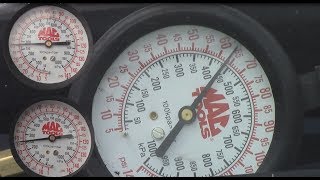
Connect a fuel pressure gauge to the fuel rail's test port. Pressure must fall within the manufacturer's specified range at idle and hold steady under acceleration. Low or dropping pressure confirms a weak fuel pump or clogged filter.
Tools: Fuel Pressure Gauge (Intermediate) - PRO TIP: Test MAF Sensor Voltage/Frequency
Check the MAF sensor's output with a scan tool. At idle on a warmed-up 2.0L-3.0L engine, expect 2-3 g/s (grams per second). This reading must increase smoothly with engine RPM, reaching 70-100 g/s at wide-open throttle. If the signal is erratic or stuck, the sensor is faulty.
Tools: Advanced OBD-II Scanner (Advanced) - PRO TIP: Test Oxygen Sensor Response Rate
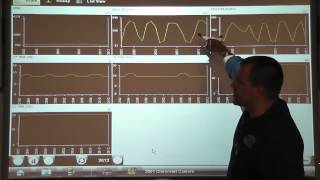
Graph the upstream O2 sensor (Bank 1, Sensor 1) voltage. A healthy narrowband sensor fluctuates rapidly between 0.1V (lean) and 0.9V (rich) at least once per second. A sensor stuck low or switching slowly is faulty, but confirm this only after ruling out vacuum and fuel issues.
Tools: Graphing OBD-II Scanner (Advanced) - PRO TIP: Test Fuel System Leakdown
After checking running fuel pressure, turn the engine off. The fuel pressure must hold steady, dropping no more than 5-7 PSI over 15 minutes. A rapid drop indicates a leaking fuel injector or a faulty check valve in the fuel pump.
Tools: Fuel Pressure Gauge (Advanced) - PRO TIP: Test Sensor Resistance
Test the Engine Coolant Temperature (ECT) sensor resistance with a multimeter. An incorrect reading that falsely tells the PCM the engine is freezing cold contributes to a lean condition once the engine warms up. Consult a service manual for the specific resistance-to-temperature chart.
Tools: Multimeter, Service Manual (Advanced)
When This Code Triggers (Freeze-Frame Conditions)
- Engine Coolant Temp: 180-200°F (82-93°C) (The engine is fully warmed up and operating in closed-loop fuel control.)
- RPM: 1500-2500 RPM (The code often sets during steady-state cruising or light acceleration, not typically at idle.)
- Engine Load: 20-50% (Occurs under a light to moderate engine load, consistent with highway cruising.)
- Vehicle Speed: 40-65 mph (Commonly triggers during steady highway driving conditions.)
Related Codes
- P0174 — This is the identical code for Bank 2. If you see both P0171 and P0174, the lean condition affects the entire engine, pointing to a shared component like the MAF sensor or fuel pump.
- P0300 — This means 'Random/Multiple Cylinder Misfire.' A severe lean condition starves the cylinders of fuel, causing a misfire. Fix the P0171 first, as it is the root cause.
- P0101 — This indicates a 'Mass Air Flow (MAF) Circuit Range/Performance' problem. If P0101 appears with P0171, the MAF sensor is the guaranteed root cause.
- P2187 — This means 'System Too Lean at Idle Bank 1.' It is a specific version of P0171 common on VW and Audi, strongly indicating a vacuum leak.
Climate & Environmental Factors
- Cold Weather: Colder, denser air requires more fuel. Plastic and rubber components contract in the cold, opening small cracks and causing vacuum leaks that seal up once the engine bay warms up.
- High Altitude: Thinner air confuses the engine's calculations. If a marginal lean condition already exists, symptoms like misfiring become highly pronounced at altitude.
- Fuel Blends: Switching between summer and winter blend gasoline causes temporary fluctuations in fuel trims as the PCM adapts to the different additive content.
How to Talk to a Mechanic About This Code
Say this: "I have a P0171 code and I'd like to schedule a diagnostic. Please check for vacuum leaks, verify MAF sensor readings, and test fuel pressure before recommending any part replacements like an oxygen sensor."
This directs the mechanic to perform specific diagnostic tests rather than jumping to conclusions, preventing the unnecessary replacement of a perfectly good oxygen sensor.
Avoid saying:
- 'My check engine light is on, can you just fix it?' (Leads to a large, open-ended diagnostic bill.)
- 'My friend said it's probably the O2 sensor.' (Leads the mechanic to replace the sensor without proper diagnosis.)
- 'Just do whatever you think is best.' (Gives up your control over the repair process and budget.)
Questions to ask before authorizing the repair:
- Can you show me the location of the vacuum leak or provide the fuel pressure and MAF sensor readings?
- Could you provide a detailed written estimate that breaks down parts, labor, and diagnostic fees?
- What is the warranty on the proposed repair, for both parts and labor?
Where to Take It: Dealer vs Independent vs Chain
- Dealer:
Recommended only if the vehicle is under warranty. For most out-of-warranty P0171 codes, a dealer is not the most cost-effective choice.
Best for: Vehicles still under a powertrain or emissions warranty., Complex, brand-specific issues where specialized software is required.
Downsides: Significantly higher labor rates and parts costs, up to 50% more than independent shops., May recommend replacing an entire assembly when only a smaller component failed. (Typical cost: +40% vs. baseline) - Independent Shop:
Best fit. A reputable independent shop has the experience and tools (smoke machine, fuel pressure gauge) to accurately diagnose P0171 at a fair price.
Best for: Out-of-warranty vehicles where cost is a major factor., Common diagnostic codes like P0171, which are caused by well-understood issues like vacuum leaks.
Downsides: Quality varies widely; vet the shop through reviews and ASE certifications., May lack the latest manufacturer-specific diagnostic tools for brand-new models. (Typical cost: +0% vs. baseline) - Chain Shop:
Use with caution. Acceptable for a visible issue like a torn intake hose, but a specialized independent shop is safer for in-depth diagnosis.
Best for: Simple, routine maintenance like oil changes or tire rotations.
Downsides: Technician diagnostic capabilities are inconsistent., Service advisors are under pressure to upsell unnecessary parts. (Typical cost: -10% vs. baseline)
When to Walk Away From the Repair
If the estimated repair cost exceeds 50% of your car's private-party value, do not fix it. For older, high-mileage cars, a lower threshold of 40% is wiser.
- Car worth $4000, fix is $2200: Walk away. The repair cost is over 50% of the car's value. Put that money toward a more reliable vehicle.
- Car worth $12000, fix is $1800: Fix it. The cost is only 15% of the vehicle's value. This is a reasonable investment to keep a valuable car running.
- Car worth $2500, fix is $1500: Walk away. The repair cost is 60% of the car's value. It is not financially sound to invest this much into a low-value vehicle.
What Scan Tool You Need for This Code
Minimum: A scanner that reads and graphs live data, specifically Short-Term Fuel Trim (STFT) and Long-Term Fuel Trim (LTFT).
A basic $20 code reader only shows the P0171 code. It lacks the live fuel trim data needed to determine if the cause is a vacuum leak or a fuel delivery issue. Without this data, you are guessing.
Budget: BlueDriver Pro Scan Tool (~$99) — Connects to your smartphone via Bluetooth to display and graph live fuel trims and O2 sensor readings. It provides freeze-frame data and Mode 6 access.
Mid-range: Foxwell NT510 Elite (~$180) — A handheld scanner providing live data, graphing, and access to manufacturer-specific codes without the price of a professional tool.
Professional: Autel MaxiCOM MK808S (~$450) — Offers comprehensive all-system diagnostics, extensive live data, and bi-directional controls to actively test components. Ideal for serious DIYers.
Rent vs buy: For a one-time fix, AutoZone lends scanners for free with a refundable deposit. If you do your own maintenance, buying the BlueDriver is a mandatory investment.
How to Clear the Code After You Fix It
- Use an OBD-II scan tool to clear the P0171 code from the PCM's memory.
- Perform a complete OBD-II drive cycle to allow the vehicle's readiness monitors to run their self-tests.
- Re-scan the vehicle to confirm the code has not returned and readiness monitors are set to 'Ready'.
Drive cycle (~30 minutes): Start with a cold engine. Idle for 3 minutes. Drive a mix of city and highway speeds. Maintain a steady speed between 55-60 mph for 10 minutes. Allow the vehicle to coast down. Park and shut off the engine.
Readiness monitors affected: Catalyst (CAT) Monitor, Oxygen (O2) Sensor Monitor, Oxygen Sensor Heater Monitor
Watch out for:
- Disconnecting the battery clears the code but resets all readiness monitors to 'Not Ready', causing an immediate emissions test failure.
- The code returns within two drive cycles if the root cause of the lean condition was not repaired.
- Failing to drive at steady highway speeds prevents the Catalyst monitor from running.
Will This Fail Emissions / State Inspection?
Yes — this code typically fails an OBD-II emissions inspection.
- California: An active P0171 code is an automatic failure. All applicable OBD readiness monitors must be set to 'Ready' to pass; clearing the code just before the test results in a failure.
- New York: The NYS DMV emissions inspection includes an OBD-II scan. A P0171 code causes an automatic failure. You cannot pass until the vehicle is repaired and completes a drive cycle.
- Texas: In the 17 Texas counties that require emissions testing, a vehicle fails the OBD-II inspection if code P0171 is present.
Most Commonly Affected Vehicles
- Ford F-150 / Expedition (V8) (1997-2008) — Caused by a leaking PCV hose rubber elbow at the back of the intake manifold. Intake manifold gaskets are also frequent culprits.
- Chevrolet / GMC Silverado / Sierra / Tahoe (4.8L, 5.3L, 6.0L V8) (1999-2007) — Caused by failing intake manifold gaskets, which become brittle and create a vacuum leak that sets both P0171 and P0174.
- BMW 3-Series (E46), 5-Series (E39), X3/X5 (M54 Engine) (1999-2006) — Prone to this code from vacuum leaks in the crankcase ventilation (CCV) system, the lower intake boot, and the DISA valve O-ring.
- Toyota Camry / RAV4 / Corolla / Matrix (1.8L & 2.4L) (2002-2011) — Triggered by failed intake manifold gaskets on the 1.8L engine. On the 2.4L, a failing Air/Fuel sensor is the primary cause.
- Honda Accord / Civic / CR-V (2003-2012) — Caused by a torn air intake hose between the MAF sensor and throttle body or a dirty MAF sensor.
- Subaru Forester / Impreza / Outback (2005-2016) — Caused by a failing front oxygen (A/F) sensor or a cracked front exhaust pipe section near the sensor.
- Volkswagen / Audi GTI / A4 / Jetta (2.0T TSI/TFSI) (2008-2015) — A torn diaphragm inside the PCV valve (oil separator) is a guaranteed failure item, creating a massive vacuum leak.
- Nissan Altima / Maxima / Frontier / Xterra (2002-2012) — Caused by a dirty MAF sensor. Cleaning the MAF sensor and throttle body is the mandatory first step.
Manufacturer-Specific Notes
- Ford: On Ford trucks, a cracked rubber PCV elbow at the back of the intake manifold is the primary cause. For 2021-2023 F-150s with the 3.3L engine, TSB 23-2195 requires a PCM software update to correct a false P0171.
- General Motors (Chevy/GMC): The plastic intake manifold gaskets on 5.3L Vortec V8 engines are a known failure point. They become brittle and cause a classic vacuum leak that triggers P0171 and P0174.
- BMW: The plastic crankcase ventilation (CCV) system cracks and creates major vacuum leaks. The lower intake boot is also famous for tearing on the underside where it is invisible from above.
- Toyota: For 2005-2006 Camry and Solara models, Toyota issued TSB EG061-05 for P0171/P0174 codes, noting that an improved Air/Fuel (A/F) sensor is required to fix the condition.
- Volkswagen / Audi: On 2.0T TSI engines, the PCV valve diaphragm is a guaranteed failure item. A tell-tale sign is a loud whistling noise from the engine bay at idle, or extreme vacuum when trying to remove the oil cap.
Real Owner Stories
2012 Honda Civic LX with 208K miles throws P0171
Check engine light came on, car went into limp mode, and suffered from 14 MPG and bad acceleration.
What they tried:
- Replaced MAF and MAP sensors, throttle body, intake hose, O2 sensors, valve cover gasket, ignition coils, and spark plugs.
- The code remained, indicating a deeper issue.
Outcome: After replacing nearly the entire intake and ignition system, the root cause was a weak fuel pump. A simple fuel pressure test would have identified this immediately.
Lesson: Never throw parts at a P0171 code. When multiple replacements fail, stop and perform fundamental tests. A $40 fuel pressure gauge saves hundreds of dollars in unnecessary parts.
2004 BMW 325i (E46) at 58K miles with P0171 & P0174
Service Engine Soon light appeared with no obvious drivability symptoms.
What they tried:
- Initial thought was a vacuum leak, but the lack of symptoms was confusing.
- Performed a professional smoke test.
Outcome: The smoke test revealed a tear in the lower intake boot on the underside where it was invisible from above. Replacing the boot resolved the lean codes.
Lesson: A visual inspection is rarely enough for modern engines. A smoke test is mandatory to find hidden tears in complex intake systems.
2005 Chevy Silverado 5.3L with P0171 and P0174
Truck had a persistent check engine light, rough idle, and reduced power.
What they tried:
- Cleaned the MAF sensor, which provided a slight improvement.
- Replaced the front O2 sensors, but the codes returned quickly.
Outcome: The root cause was failed intake manifold gaskets. The original plastic gaskets became brittle and created a massive vacuum leak. Replacing them with updated Fel-Pro gaskets permanently solved the problem.
Lesson: When P0171 and P0174 appear together on a GM Vortec V8, intake manifold gaskets are the highest-probability failure point.
How to Prevent This Code From Triggering
- Use Top-Tier Certified Gasoline (Every fill-up) — Top Tier gas contains significantly more detergent additives, preventing deposits from clogging fuel injectors and restricting fuel flow.
- Clean the MAF Sensor Periodically (Every 1-2 years or with every air filter change.) — Dust and oil vapors coat the delicate sensor wire, causing it to under-report airflow. Cleaning it prevents one of the most common causes of P0171.
- Replace Upstream Oxygen (A/F) Sensors Proactively (Once every 100,000 miles.) — Oxygen sensors degrade and become slow. A slow sensor forces the ECU to make incorrect adjustments that stress the catalytic converter.
- Inspect Vacuum Hoses and Intake Boots (During every oil change.) — Engine heat causes rubber hoses to become brittle. A quick physical inspection catches potential vacuum leaks before they trigger a code.
Frequently Asked Questions
What does 'Bank 1' mean?
Bank 1 is the side of the engine containing cylinder number 1. On an inline-four engine, there is only one bank. On US-market V-engines, Bank 1 is typically the passenger's side.
Can a loose gas cap cause a P0171 code?
No. A loose gas cap affects the evaporative emission (EVAP) system and triggers codes like P0455 or P0457, not a fuel mixture code.
I replaced the oxygen sensor, but the code came back. Why?
The oxygen sensor is like a smoke detector; it reports the fire but didn't start it. It is correctly reporting a lean condition caused by a vacuum leak, dirty MAF sensor, or fuel delivery issue. Always diagnose the root cause before replacing the O2 sensor.
What is the easiest way to check for a vacuum leak at home?
With the engine idling, carefully spray short bursts of brake cleaner or unlit propane around intake gaskets and vacuum hoses. If the idle speed suddenly changes, you found the leak. Exercise extreme caution, as these sprays are highly flammable.
How can I tell if it's a vacuum leak or a fuel problem using a scan tool?
Watch your live fuel trims. If trims are high (+20%) at idle but drop to normal at 2,500 RPM, you have a vacuum leak. If trims stay high or increase at higher RPMs, you have a fuel delivery or MAF issue.
Is it expensive to fix code P0171?
Costs range from $15 for a DIY MAF sensor cleaning to over $1,200 for a professional fuel pump replacement. A professional diagnosis costs $100 to $150. Paying for diagnosis prevents wasting money on unnecessary parts.
Can a bad PCV valve cause a P0171 code?
Yes. A PCV valve stuck open or a cracked PCV hose acts as a massive unmetered vacuum leak, directly triggering a P0171 code.
What are fuel trims?
Fuel trims are the percentage of fuel the PCM adds or subtracts to maintain the perfect air-fuel ratio. Positive trims mean the computer is adding fuel to fix a lean condition. For P0171, you will see high positive fuel trim values exceeding +15%.
Key Takeaways
- Code P0171 triggers when the engine computer adds more than 25% extra fuel to Bank 1 to compensate for an uncorrected lean condition.
- Check for vacuum leaks and clean the Mass Airflow (MAF) sensor with a $15 dedicated spray before replacing any expensive parts.
- Never replace the oxygen sensor as a first step; it is usually functioning perfectly by reporting the lean condition caused by a vacuum or fuel issue.
- Use an OBD-II scanner to watch live fuel trims: if the trim drops from +20% at idle to near 0% at 2,500 RPM, you have a vacuum leak.
- Driving with an active P0171 code for more than 100 miles causes extreme exhaust temperatures that can melt a $1,500 catalytic converter.
Helpful Videos

Shop the Parts Behind P0171
Below are the parts most often responsible for code P0171, ranked by how frequently each one is the actual culprit (per the diagnosis above). Tap any to see what we have for your vehicle.



The information in this article is provided for general reference and educational purposes only. Vehicle specifications, procedures, and part compatibility can vary by production date, trim level, and region. Always consult your vehicle's factory service manual and verify part numbers before purchasing or performing repairs. Safety-critical components such as airbags, seat belts, and braking systems should be installed by a qualified professional.
- 🧭 Diagnostic Flowchart
- 🎬 Helpful Videos
- 🛍️ Shop This Part
- What Does P0171 Mean?
- Can I Drive With P0171?
- Common Causes
- Symptoms
- Common Fixes & Costs
- DIY vs Professional
- Used vs. New Parts: Buying Guide
- What Happens If You Wait — Timeline
- Cost of Not Fixing It
- Diagnosis Steps
- When This Code Triggers (Freeze-Frame Conditions)
- Related Codes
- Climate & Environmental Factors
- How to Talk to a Mechanic About This Code
- Where to Take It: Dealer vs Independent vs Chain
- When to Walk Away From the Repair
- What Scan Tool You Need for This Code
- How to Clear the Code After You Fix It
- Will This Fail Emissions / State Inspection?
- Most Commonly Affected Vehicles
- Manufacturer-Specific Notes
- Real Owner Stories
- 2012 Honda Civic LX with 208K miles throws P0171
- 2004 BMW 325i (E46) at 58K miles with P0171 & P0174
- 2005 Chevy Silverado 5.3L with P0171 and P0174
- How to Prevent This Code From Triggering
- Frequently Asked Questions
- What does 'Bank 1' mean?
- Can a loose gas cap cause a P0171 code?
- I replaced the oxygen sensor, but the code came back. Why?
- What is the easiest way to check for a vacuum leak at home?
- How can I tell if it's a vacuum leak or a fuel problem using a scan tool?
- Is it expensive to fix code P0171?
- Can a bad PCV valve cause a P0171 code?
- What are fuel trims?
- Key Takeaways