

OBD-II Code P0300: Ultimate Guide to Random/Multiple Cylinder Misfire
What P0300 means, why it triggers, and the definitive guide to diagnosing and fixing it.
- P0300 flags random misfires across multiple cylinders, meaning the engine's computer detects a systemic fuel, spark, or air imbalance rather than a single isolated failure.
- Worn spark plugs and failing ignition coils cause roughly 40% of P0300 codes, making the ignition system the most statistically likely starting point for diagnosis.
- A flashing check engine light demands an immediate stop; driving with a severe misfire destroys a catalytic converter in minutes, turning a $100 repair into a $2,500+ replacement.
- Checking Mode $06 misfire data and live fuel trims with an advanced OBD-II scanner pinpoints the exact failing component, preventing hundreds of dollars wasted on the 'parts cannon' approach.
- If fuel trims exceed +/- 10% or you lack a bidirectional scanner, pay the $100-$180 diagnostic fee at a professional shop to avoid replacing unnecessary parts.
What Does P0300 Mean?
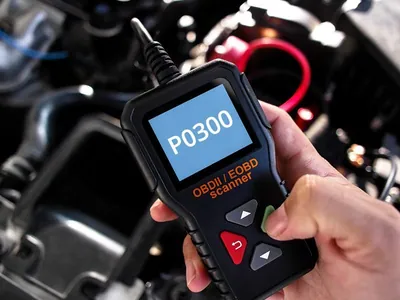
The P0300 code means your car's Engine Control Module (ECM) detects that one or more cylinders are not firing correctly. This indicates misfires are happening randomly across multiple cylinders, suggesting a systemic issue affecting the entire engine rather than a single isolated failure. A common misconception is that the computer doesn't know which cylinder is at fault; it usually does, but the misfire rate hasn't reached the threshold to trigger a cylinder-specific code (like P0301), so it logs the general P0300 code.
Technical definition: The official SAE definition for P0300 is "Random/Multiple Cylinder Misfire Detected." This indicates the powertrain control module (PCM) detects a misfire by monitoring variations in the crankshaft's rotational speed, but the misfire is not isolated to a specific cylinder or has not met the threshold to trigger a cylinder-specific code.
Can I Drive With P0300?

Yes, But With Caution. You can drive short distances with a steady check engine light, but extended driving risks severe engine damage. A steady light means misfires are occurring but remain below the immediate damage threshold. However, if the check engine light is flashing, you must pull over and stop driving immediately. A flashing light signals a severe misfire dumping unburned fuel into the exhaust, destroying the catalytic converter in minutes—a repair often costing $1,500-$2,500+. Ignoring even a steady light leads to oil dilution, internal engine wear, and eventual catalytic converter failure.
Common Causes

- Worn or faulty spark plugs (Very Common) — Spark plugs are the single most frequent cause of a P0300 code, responsible for an estimated 40% of cases. Over time, electrodes wear out, gaps widen, or they become fouled with carbon, preventing them from creating a spark strong enough to ignite the fuel-air mixture.
- Failing ignition coils or coil packs (Common) — Ignition coils transform the battery's 12 volts into the 20,000+ volts needed for a spark. Weak or failing coils fail to deliver this voltage. A leaking valve cover gasket also causes oil to pool in spark plug tubes, shorting out the coil and plug.
- Vacuum leaks (Common) — Engines require a precise air-fuel mixture. A vacuum leak from a cracked hose, bad PCV valve, or leaking intake manifold gasket lets unmetered air into the engine. This creates a lean condition that causes misfires, often indicated by white deposits on spark plugs.
- Fuel delivery problems (Common) — A weak fuel pump, clogged fuel filter, or dirty fuel injectors starve the engine of fuel. This leads to incomplete combustion and lean misfires, especially noticeable under heavy acceleration.
- Contaminated or poor-quality fuel (Less Common) — Using low-octane fuel, water-contaminated gas, or high-ethanol blends in a non-flex-fuel vehicle disrupts combustion and triggers random misfires. If P0300 appears shortly after refueling, this is the primary suspect.
- Faulty sensors (MAF, Crankshaft, O2) (Less Common) — The PCM relies on sensor data to run the engine. A dirty Mass Airflow (MAF) sensor causes an incorrect air-fuel mixture. A failing Crankshaft Position sensor disrupts ignition timing. A faulty Oxygen (O2) sensor forces incorrect fuel trim adjustments, leading to misfires.
- Clogged Catalytic Converter (Less Common) — While misfires destroy catalytic converters, a pre-existing clogged converter also causes a P0300 code. The blockage creates excessive exhaust backpressure, choking the engine and causing misfires at higher RPMs.
- Faulty or Clogged EGR Valve (Less Common) — The Exhaust Gas Recirculation (EGR) valve reduces emissions by reintroducing exhaust gas into the combustion chamber. A valve stuck open allows a continuous flow of exhaust into the intake, disrupting the air-fuel mixture and causing a rough idle and random misfires.
- Low engine compression (Rare) — Mechanical failures like a leaking head gasket, worn piston rings, damaged valves, or a stretched timing chain cause low compression. The cylinder cannot properly compress the air-fuel mixture, resulting in a dead misfire.
Symptoms
- Check Engine Light is on or flashing — A solid light indicates a detected misfire. A flashing light signals a severe, catalyst-damaging misfire happening in real-time.
- Rough engine idle and vibration — The engine shakes, stutters, or vibrates noticeably when stopped, in park, or at low speeds.
- Engine hesitation or stumbling during acceleration — The car feels jerky, lacks power, or stumbles when pressing the gas pedal.
- Reduced fuel economy — Fuel efficiency drops significantly because the engine is wasting unburned fuel.
- Fuel smell from the exhaust — A strong smell of raw gasoline from the tailpipe indicates unburned fuel passing through the engine into the exhaust system.
- Difficulty starting the engine — The engine takes longer than usual to start or cranks without starting during severe misfire conditions.
Diagnostic Flowchart
Tap your situation to follow the diagnostic path that matches what you're seeing on this code.
Common Fixes & Costs
- Replace spark plugs
— Parts: $20-$100, Labor: $80-$350, ~1.5 hr book time
(DIY)
: OEM
: OEM - Replace ignition coil(s)
— Parts: $40-$120 per coil, Labor: $50-$160, ~1 hr book time
(DIY)
: OEM
: OEM - Repair a vacuum leak — Parts: $5-$50, Labor: $100-$200, ~1.5 hr book time (Intermediate)
- Replace fuel pump — Parts: $200-$500, Labor: $500-$1,500, ~4 hr book time (Professional)
- Clean or replace fuel injectors — Parts: $50-$150 per injector, Labor: $150-$500+, ~2.5 hr book time (Professional)
- Intake valve carbon cleaning (GDI engines) — Parts: $50, Labor: $500-$1,500+, ~5 hr book time (Professional)
- Replace catalytic converter — Parts: $400-$2,000+, Labor: $200-$500, ~2 hr book time (Professional)
DIY vs Professional
- Replace spark plugs — Beginner: True
- Replace ignition coil(s) — Beginner: True
- Repair a vacuum leak — Beginner: False
- Replace fuel pump — Beginner: False
- Clean or replace fuel injectors — Beginner: False
- Intake valve carbon cleaning (GDI engines) — Beginner: False
- Replace catalytic converter — Beginner: False
Used vs. New Parts: Buying Guide
When a used part is worth it: Used parts are never recommended for common P0300 causes like spark plugs and ignition coils. A used OEM catalytic converter from a low-mileage donor vehicle is a cost-effective option for older cars.
Donor-vehicle mileage cap: roughly under 60000 miles for the part to have meaningful remaining life.
Donor quality checklist:
- Verify the donor vehicle was not scrapped due to engine or emissions problems.
- Ensure the catalytic converter is an OEM part, not a less-durable aftermarket unit.
- Match part numbers exactly; visual similarity does not guarantee compatibility.
- Avoid parts from rust-belt states if corrosion is a concern.
Decision logic:
- If Part is a wear item like a spark plug, ignition coil, or sensor → Always buy new. The risk of premature failure on a used part is too high.
- If Part is an expensive, non-wear item like a catalytic converter and the vehicle is over 10 years old → A used OEM part from a low-mileage donor is a reasonable choice on a tight budget.
- If Vehicle is under warranty or less than 5 years old → Use new OEM parts to maintain reliability and warranty coverage.
Warranty tradeoff: Used parts typically have a 30-90 day warranty covering the part only. New aftermarket parts offer 1-year to limited lifetime warranties. New OEM parts offer a 1-2 year warranty.
Worst-case if a used part fails: $500-2000 if a major used part like a catalytic converter fails, requiring a second labor charge and replacement part.
What Happens If You Wait — Timeline
- 0-2 weeks: A steady Check Engine Light appears. Misfires are logged but may not be noticeable except for a slight rough idle on cold starts. (MPG impact: 0-5%% · Added cost: $0-$50 in wasted fuel)
- 2 weeks - 3 months: Misfires become frequent. Fuel economy drops, and the engine hesitates during acceleration. The catalytic converter begins experiencing periodic overheating. (MPG impact: 10-20%% · Added cost: $50-$250 in wasted fuel + early stage O2 sensor/catalyst stress)
- 3-6 months: The Check Engine Light flashes during heavy acceleration. The catalytic converter substrate is permanently damaged from sustained high temperatures. The car fails emissions tests. (MPG impact: 20-30%% · Added cost: $1,500 - $3,500 (Catalytic converter replacement is required))
- 6+ months: Catastrophic failure. The catalytic converter becomes completely clogged, creating extreme exhaust backpressure. This causes severe power loss, stalling, and internal engine damage like burned exhaust valves. (MPG impact: 30-50%+% · Added cost: $2,500 - $7,000+ (Catalytic converter plus engine repairs))
Cost of Not Fixing It
- Immediate (flashing light): Catalytic converter overheating and melting internally due to raw fuel being dumped into it. (Added cost: $1200-$3500)
- 1-3 months (steady light): Significant drop in fuel economy (10-25%), potential damage to oxygen sensors from fuel contamination. (Added cost: $200-$600)
- 6+ months (steady light): Guaranteed catalytic converter failure, potential internal engine damage from fuel washing oil off cylinder walls, leading to worn piston rings. (Added cost: $2500-$7000+)
Diagnosis Steps

- Scan for Codes, Check Freeze Frame & Mode $06 Data
Use an advanced OBD-II scanner to confirm P0300 and check for other codes. Freeze frame data shows engine conditions when the misfire occurred. Crucially, check Mode $06 data. It contains misfire counts for each specific cylinder, immediately pointing you to the problem area even if only a general P0300 code is set.
Tools: Advanced OBD-II Scanner (Beginner) - Analyze Fuel Trim Data (STFT & LTFT)
Use live data to observe Short-Term (STFT) and Long-Term (LTFT) fuel trims at idle and at 2,500 RPM. Ideal values are within +/- 5%. Values consistently between +10% to +25% indicate a lean condition, strongly suggesting a vacuum leak or weak fuel delivery. Values consistently between -10% to -25% indicate a rich condition, pointing to a leaking fuel injector or faulty O2 sensor.
Tools: Advanced OBD-II Scanner (Advanced) - Perform a Thorough Visual Inspection
Look for obvious problems: cracked or disconnected vacuum hoses, loose electrical connectors on coils and sensors, damaged spark plug wires, signs of rodent damage, and evidence of oil or coolant leaks around the engine.
Tools: Flashlight, Inspection Mirror (Beginner) - Inspect and Test the Ignition System
Remove and inspect spark plugs for wear, fouling, or white deposits. If you suspect a bad ignition coil and have cylinder-specific misfire data from Mode $06, swap the suspected bad coil with a known good coil from another cylinder. Clear codes and see if the misfire follows the coil to the new cylinder.
Tools: Spark plug socket, ratchet, ignition coil puller (Intermediate) - Check for Vacuum Leaks
If fuel trims suggest a lean condition, confirm the vacuum leak. The professional method uses a smoke machine to fill the intake system with vaporized mineral oil, making leaks visible. A DIY alternative is carefully spraying short bursts of carburetor cleaner around the intake manifold gasket and vacuum hoses with the engine running; a change in RPM indicates the leak source.
Tools: Smoke machine or carburetor cleaner (Intermediate) - Test Fuel Pressure and Volume
Connect a fuel pressure gauge to the fuel rail's test port. Check that pressure is within the manufacturer's specified range (often 45-60 PSI for port injection). A weak fuel pump might provide adequate pressure at idle but fail to keep up with demand during acceleration, causing a lean misfire.
Tools: Fuel pressure gauge (Intermediate) - Test Key Sensor Values
View live data from key sensors. A MAF sensor should read approximately 1 gram/second per liter of engine displacement at idle. A healthy upstream O2 sensor fluctuates rapidly between 0.1V and 0.9V. Watch for a consistent RPM signal from the Crankshaft Position Sensor while cranking.
Tools: Advanced OBD-II Scanner (Advanced) - Test for Exhaust Backpressure
To check for a clogged catalytic converter, use an exhaust backpressure gauge in the upstream oxygen sensor port. At idle, pressure should be near zero. At 2,500 RPM, it should not exceed 1.5-2.0 PSI. Readings higher than 3 PSI indicate a significant restriction causing the P0300.
Tools: Exhaust backpressure gauge, O2 sensor socket (Advanced) - Perform an Engine Compression Test
If other tests fail, check the engine's mechanical health. Each cylinder should have a compression of 130 PSI or higher, and variation between the highest and lowest cylinder must not exceed 10-15%. Low compression points to a serious mechanical issue.
Tools: Compression tester (Advanced) - Perform a Cylinder Leak-Down Test
Following a failed compression test, a leak-down test pinpoints the source of compression loss. Leakage above 20% indicates a problem. Listen for escaping air in the intake (intake valve), exhaust pipe (exhaust valve), or oil filler cap (piston rings) to identify the failed component.
Tools: Cylinder leak-down tester, Air compressor (Advanced)
When This Code Triggers (Freeze-Frame Conditions)
- Engine Coolant Temp: 175-195°F (Fully warmed up)
- RPM: 600-1200 (At idle or just off-idle)
- Engine Load: 20-40% (Low load, such as idling in gear or light acceleration)
- Vehicle Speed: 0-15 mph (At a stop or in slow-moving traffic)
Related Codes
- P0301-P0312 — These specify which cylinder is misfiring (e.g., P0301 for cylinder 1). P0300 often appears alongside these. If you only have P0300, the misfire is random or hasn't met the threshold for a specific cylinder code.
- P0171 / P0174 — These indicate the engine is running too lean. They frequently accompany P0300 because the root cause, like a vacuum leak or weak fuel pump, creates both a lean condition and a random misfire. Prioritize diagnosing vacuum leaks and fuel pressure.
- P0420 / P0430 — These signal low catalytic converter efficiency. A persistent P0300 misfire dumps unburned fuel into the exhaust, destroying the catalytic converter and triggering P0420/P0430. Conversely, a pre-existing clogged converter creates backpressure, causing a P0300.
- P0507 — Indicates engine idle speed is higher than expected. It often appears with P0300 when a significant vacuum leak is present. Unmetered air causes the idle to surge and the mixture to run lean, resulting in misfires.
Climate & Environmental Factors
- Cold Weather: Low temperatures cause or worsen P0300. Thick oil strains the battery, slowing cranking speed and weakening spark voltage. Metal and plastic components contract, temporarily opening vacuum leaks, and fuel atomizes poorly during cold starts.
- High Humidity: Moisture lowers the insulating properties of spark plug wires, boots, and coil packs. This makes it easier for the high-voltage spark to arc to ground instead of jumping the plug gap, causing a misfire.
- High Altitude: Less dense air at high altitudes means fewer oxygen molecules for combustion. While modern engines compensate, this exposes underlying weaknesses in fuel or ignition systems, making misfires more noticeable.
How to Talk to a Mechanic About This Code
Say this: "I have a P0300 random misfire code and I'd like to schedule a diagnostic. Can you please check the freeze frame data and look at the Mode $06 misfire counters to start? I'd also like to know what the long-term fuel trims are at idle and 2,500 RPM."
This signals you've done your research and are requesting a data-driven diagnosis. It prevents a shop from immediately replacing expensive parts without evidence and focuses them on key diagnostic data that reveals the true cause.
Avoid saying:
- 'My check engine light is on, can you just fix it?'
- 'My car is shaking, I think it needs a tune-up.'
- 'Just do whatever you think is necessary.'
Questions to ask before authorizing the repair:
- Can you show me the freeze frame data and the Mode $06 misfire counts for each cylinder?
- If you suspect a vacuum leak, how will you test for it? (A smoke test is the professional standard).
- If you're recommending a catalytic converter, did you confirm it's clogged with a backpressure test or that it failed by observing the downstream O2 sensor readings?
- What is the warranty on the parts and labor for this specific repair?
Where to Take It: Dealer vs Independent vs Chain
- Dealer:
Recommended only if the vehicle is under warranty or has a known, complex, manufacturer-specific issue that independent shops cannot handle.
Best for: Vehicles still under a powertrain or emissions warranty., Known manufacturer-specific quirks or TSBs related to P0300., Complex electrical issues requiring proprietary software updates.
Downsides: Highest labor rates, often 1.5x to 2x more than independent shops., May recommend replacing larger, more expensive assemblies rather than individual components. (Typical cost: +50% vs. baseline) - Independent Shop:
Best fit for most P0300 scenarios. A good independent shop with ASE-certified technicians effectively diagnoses and repairs the vast majority of P0300 causes at a reasonable cost.
Best for: Most out-of-warranty vehicles., Diagnosing and repairing common P0300 causes (spark plugs, coils, vacuum leaks, fuel pumps)., Building a long-term relationship with a trusted mechanic.
Downsides: Shop quality and diagnostic skill vary widely; vetting through online reviews and ASE certifications is crucial., May lack access to the latest manufacturer-specific software for brand-new models. (Typical cost: +0% vs. baseline) - Chain Shop:
Use with caution. Acceptable for replacing spark plugs or a single ignition coil if you've diagnosed the problem yourself. AVOID for initial P0300 diagnosis due to the high risk of unnecessary parts replacement.
Best for: Simple, straightforward parts replacement like spark plugs if you already have a firm diagnosis.
Downsides: Technician skill and experience are inconsistent., Business model creates high pressure to upsell services like fuel system flushes., Often not equipped for in-depth P0300 diagnosis, leading to a 'parts cannon' approach. (Typical cost: -10% vs. baseline)
When to Walk Away From the Repair
If the repair cost exceeds 40-50% of the vehicle's private-party value, it's time to seriously consider selling or trading in the vehicle.
- Car worth $4000, fix is $2000: Borderline. The repair is 50% of the car's value. Get a second opinion before authorizing, as another major repair could be right around the corner.
- Car worth $12000, fix is $1800: Fix it. The repair is only 15% of the car's value and is well below the walk-away threshold.
- Car worth $2500, fix is $1500: Walk away. The repair cost is 60% of the car's value, far exceeding the threshold. Investing this much into an older, low-value car is rarely a sound financial decision.
What Scan Tool You Need for This Code

Minimum: An OBD-II scanner that reads live data streams (especially fuel trims) and accesses Mode $06 misfire counters.
A basic $20 code reader only shows the P0300 code itself. It cannot show individual cylinder misfire counts hidden in Mode $06 or live fuel trim data essential for diagnosing vacuum leaks or fuel delivery issues. Without this data, you are forced to guess and replace parts.
Budget: BlueDriver Pro Scan Tool (~$100) — Connects to your smartphone via Bluetooth. It reads and clears codes, provides repair reports, views live data (fuel trims, O2 sensor readings), and accesses Mode $06 data to see which cylinders are misfiring.
Mid-range: Foxwell NT510 Elite (~$180) — A powerful handheld scanner providing manufacturer-specific diagnostics. It offers all features of the budget pick plus bidirectional controls, allowing you to command components like fuel pumps or injectors to test their function.
Professional: Autel MaxiCOM MK808 / MK808BT (~$450-600) — A professional-grade tablet scanner. For a P0300, it provides full access to live data, Mode $06, and advanced OEM-level bidirectional controls (like performing a cylinder power balance test to isolate the misfiring cylinder).
Rent vs buy: Auto parts stores scan codes for free, but usually just give you the code itself. For a P0300, where live data and Mode $06 are critical, renting isn't viable. Buying a capable scanner like the BlueDriver is a worthwhile investment that saves money compared to a single diagnostic fee.
How to Clear the Code After You Fix It
- Use an OBD-II scan tool to clear the code
- Perform a complete OBD-II drive cycle
Drive cycle (~20 minutes): Start the engine cold and idle for 2-3 minutes. Drive in stop-and-go traffic for 5-10 minutes, including accelerations and decelerations. Drive at a steady highway speed (55-60 mph) for 5-10 minutes. Let the vehicle cool down completely.
Readiness monitors affected: Misfire Monitor, Catalyst (CAT) Monitor, Evaporative (EVAP) System Monitor, Oxygen (O2) Sensor Monitor
Before emissions retest: drive at least 50 miles to fully set monitors.
Watch out for:
- Disconnecting the battery clears the code but resets all readiness monitors, guaranteeing an emissions test failure.
- The code returns immediately if the underlying mechanical or electrical fault is not repaired.
- Failing to complete the full drive cycle leaves readiness monitors incomplete, preventing emissions testing.
Will This Fail Emissions / State Inspection?
Yes — this code typically fails an OBD-II emissions inspection.
- California: An active P0300 code is an automatic failure. All OBD-II readiness monitors must be 'Ready'. A flashing check engine light is grounds for immediate test refusal.
- New York: The NYS DMV inspection includes an OBD-II scan. A P0300 code causes an automatic failure of the emissions portion.
- Texas: In the 17 counties requiring emissions testing, a P0300 code results in an automatic failure of the OBD-II inspection.
Most Commonly Affected Vehicles
- Chevrolet / GMC Silverado, Sierra, Equinox, Tahoe (2007-2020) — V8 models with Active Fuel Management (AFM) are prone to P0300 from failing AFM lifters, a repair exceeding $2,000. 2.4L Equinox models (2013-2017) suffer high oil consumption leading to fouled plugs.
- Ford F-150 / Ranger / Explorer (2004-2023) — Often caused by ignition system components. 5.4L 3V Triton engines have issues with spark plugs breaking during removal. Some 2013 Mustangs require a PCM recalibration for false P0300 codes.
- Nissan Altima / Titan / Frontier / Xterra (2002-2023) — High incidence of P0300 codes linked to failing ignition coils or crankshaft position sensors. Multiple recalls exist for sensors causing stalling or misfires.
- Hyundai / Kia Sonata, Tucson, Optima, Sportage (2011-2022) — GDI engines are highly susceptible to P0300 due to excessive carbon buildup on intake valves, requiring labor-intensive walnut blasting.
- Subaru Forester / Outback / Impreza (2005-2018) — On 2014-2016 Foresters (2.5L), P0300 is frequently caused by a faulty alternator creating electrical noise misinterpreted as a misfire. TSB #07-112-16R requires replacing the alternator and belt tensioner.
- Volkswagen / Audi Jetta, Golf, Passat, Tiguan, A4 (2009-2018) — Prone to carbon buildup, failing PCV valves, and ignition coils. VW issued TSBs requiring ECM software updates to correct false misfire detection.
- Dodge / Ram / Chrysler Ram 1500, Charger, Grand Caravan (2005-2020) — HEMI V8 engines develop the 'Hemi tick' from a failed lifter roller, leading to a P0300 code. Ignition coils and spark plugs are also common failure points.
- Toyota Camry / Corolla / Tacoma (2002-2018) — Generally reliable, but experience P0300 from aging ignition coils, vacuum leaks from hardened intake manifold gaskets, or dirty mass airflow sensors.
Manufacturer-Specific Notes
- General Motors (Chevrolet, GMC): On V8 engines with Active Fuel Management (AFM), P0300 is often caused by a stuck AFM lifter, causing a persistent misfire the ECU logs as random. This is an expensive, labor-intensive repair.
- Ford: On some 2013 Mustangs, TSB 13-1-11 addresses false P0300 codes appearing without driveability issues, fixed via PCM recalibration. On 5.4L 3V Triton engines, spark plugs frequently break off in the cylinder head during removal.
- Subaru: On 2014-2016 Foresters, a failing alternator produces electrical interference the ECU misinterprets as a P0300 misfire. TSB 07-112-16R advises replacing the alternator and belt tensioner, not ignition components.
- Volkswagen / Audi: VW issued TSBs requiring an ECM software update to correct false misfire detection. After repairs like a timing chain replacement, the crankshaft adaptation must be reset to prevent false P0300 codes.
Real Owner Stories
2014 Mazda 6 at 110K miles - The Misleading 'Fix'
Check engine light came on with a P0300 code. A mechanic replaced all 4 spark plugs. The light returned 3 days later.
What they tried:
- Replaced all 4 spark plugs - code returned.
- Used higher-octane fuel for several tanks to clean carbon buildup - code returned after going back to regular fuel.
Outcome: The issue was intermittent. The owner suspected the issue was related to fuel quality or a deeper carbon buildup problem on the GDI engine.
Lesson: If a simple fix like spark plugs doesn't solve a P0300, investigate systemic issues like fuel quality or carbon buildup, especially on GDI engines. Using high-octane fuel was likely masking the underlying issue.
2000 Ford F-150 5.4L with 225K miles - The Vacuum Leak Hunt
Car presented with a rough idle and multiple codes: P0300 (random misfire), P0171 (lean bank 1), and P0174 (lean bank 2).
What they tried:
- Replaced all spark plugs and coil packs.
- Cleaned the Mass Airflow (MAF) sensor.
- Searched for vacuum leaks visually.
Outcome: A professional technician identified that P0171 and P0174 almost always indicate a significant vacuum leak. The culprit was a dry-rotted 90-degree vacuum elbow behind the throttle body.
Lesson: When P0300 is paired with dual lean codes (P0171/P0174), stop focusing on ignition components and prioritize finding a vacuum leak affecting the whole engine.
2007-2013 GM Truck/SUV - The Hidden Water Intrusion
A GM truck experienced an intermittent P0300, sometimes with lean/rich codes (P0171/P0174), especially after a car wash or heavy rain.
What they tried:
- Standard diagnosis for misfires (plugs, coils, injectors) found no faults.
Outcome: A GM Technical Service Bulletin (TSB PIP3056) identified water getting into the oxygen sensor connectors. This skewed the O2 sensor voltage, causing the ECM to incorrectly adjust fuel trim, leading to random misfires.
Lesson: For vehicle-specific, intermittent electrical gremlins, always search for TSBs related to your code. The problem isn't always the component itself but its wiring or connector.
How to Prevent This Code From Triggering
- Use Top Tier certified gasoline exclusively (Every fill-up) — Top Tier fuels contain significantly higher levels of detergent additives that prevent and clean carbon deposits from fuel injectors and intake valves, reducing the chance of lean misfires.
- Perform periodic fuel system cleaning (Every 5,000-10,000 miles) — For GDI engines, where fuel doesn't wash over intake valves, carbon buildup is a major cause of P0300. Using a quality fuel additive with PEA helps clean injectors and mitigates buildup.
- Replace oxygen sensors proactively (Every 60,000 to 100,000 miles) — O2 sensors degrade and become 'lazy,' sending slow data to the ECU. This causes incorrect air-fuel mixtures, leading to misfires long before the sensor fails completely.
- Follow manufacturer's spark plug replacement interval (Typically 60,000 to 100,000 miles) — Spark plugs are the most common cause of P0300. As electrodes wear, the gap widens, requiring higher voltage to fire. This strains the ignition coil and leads to weak spark.
- Perform occasional 'Italian tune-up' (for GDI) (Monthly) — GDI engines used for short trips are prone to carbon buildup. Sustained higher RPM driving increases combustion temperatures and airflow, burning off soft carbon deposits from valves and pistons.
Frequently Asked Questions
What's the difference between a P0300 and a P0301 code?
A P0300 code means misfires are random or happening on multiple cylinders. A P0301 code is specific to cylinder #1 and indicates a consistent misfire. You can have P0300 by itself or combined with cylinder-specific codes.
I've replaced the spark plugs and ignition coils, but the P0300 code is still there. What's next?
After addressing the ignition system, check the fuel system and look for vacuum leaks. High positive fuel trims strongly suggest a vacuum leak, while low fuel pressure points to a weak pump. If those pass, investigate a clogged EGR valve, dirty MAF sensor, or restricted catalytic converter.
Can bad gas cause a P0300 code?
Yes. Fuel that is old, contaminated with water, or has an improper octane rating causes incomplete combustion and random misfires. If the code appeared right after filling your tank, contaminated fuel is the primary suspect.
Will a fuel additive like Seafoam fix a P0300 code?
Fuel additives only help if the misfire stems from lightly clogged fuel injectors. They will not fix a bad ignition coil, vacuum leak, weak fuel pump, or mechanical engine damage. Treat additives as preventative maintenance rather than a cure for an active P0300.
What are common mistakes when diagnosing a P0300?
The biggest mistake is the 'parts cannon' approach—replacing parts without confirming they are bad. Another is ignoring diagnostic data; checking fuel trims and Mode $06 misfire counters pinpoints the problem in minutes. Finally, ruling out mechanical issues or a clogged exhaust early on leads to dead-end diagnoses.
Why is my check engine light flashing?
A flashing check engine light is an urgent warning of a severe, catalyst-damaging misfire happening in real-time. Unburned fuel is entering the exhaust and will overheat and destroy your catalytic converter in minutes. Pull over and turn off the engine immediately.
Can a bad oxygen (O2) sensor cause a P0300 code?
Yes. A faulty or 'lazy' oxygen sensor sends incorrect information to the car's computer, causing it to create an overly rich or lean air-fuel mixture. This incorrect mixture leads to random misfires across all cylinders.
How much does it cost to diagnose a P0300 code?
Most repair shops charge a diagnostic fee ranging from $100 to $180 for the initial investigation. This covers reading codes, checking freeze frame data, and a visual inspection. Complex issues requiring smoke tests or compression tests increase the diagnostic cost.
Can I fix a P0300 code myself?
You can fix simple causes like worn spark plugs or loose vacuum hoses with basic hand tools. However, because P0300 stems from many complex systems, advanced diagnostics are often required. If you cannot read live fuel trims or Mode $06 data, take the vehicle to a professional.
Key Takeaways
- P0300 flags random misfires across multiple cylinders, meaning the engine's computer detects a systemic fuel, spark, or air imbalance rather than a single isolated failure.
- Worn spark plugs and failing ignition coils cause roughly 40% of P0300 codes, making the ignition system the most statistically likely starting point for diagnosis.
- A flashing check engine light demands an immediate stop; driving with a severe misfire destroys a catalytic converter in minutes, turning a $100 repair into a $2,500+ replacement.
- Checking Mode $06 misfire data and live fuel trims with an advanced OBD-II scanner pinpoints the exact failing component, preventing hundreds of dollars wasted on the 'parts cannon' approach.
- If fuel trims exceed +/- 10% or you lack a bidirectional scanner, pay the $100-$180 diagnostic fee at a professional shop to avoid replacing unnecessary parts.
Shop the Parts Behind P0300
Below are the parts most often responsible for code P0300, ranked by how frequently each one is the actual culprit (per the diagnosis above). Tap any to see what we have for your vehicle.



The information in this article is provided for general reference and educational purposes only. Vehicle specifications, procedures, and part compatibility can vary by production date, trim level, and region. Always consult your vehicle's factory service manual and verify part numbers before purchasing or performing repairs. Safety-critical components such as airbags, seat belts, and braking systems should be installed by a qualified professional.
- 🧭 Diagnostic Flowchart
- 🛍️ Shop This Part
- What Does P0300 Mean?
- Can I Drive With P0300?
- Common Causes
- Symptoms
- Common Fixes & Costs
- DIY vs Professional
- Used vs. New Parts: Buying Guide
- What Happens If You Wait — Timeline
- Cost of Not Fixing It
- Diagnosis Steps
- When This Code Triggers (Freeze-Frame Conditions)
- Related Codes
- Climate & Environmental Factors
- How to Talk to a Mechanic About This Code
- Where to Take It: Dealer vs Independent vs Chain
- When to Walk Away From the Repair
- What Scan Tool You Need for This Code
- How to Clear the Code After You Fix It
- Will This Fail Emissions / State Inspection?
- Most Commonly Affected Vehicles
- Manufacturer-Specific Notes
- Real Owner Stories
- 2014 Mazda 6 at 110K miles - The Misleading 'Fix'
- 2000 Ford F-150 5.4L with 225K miles - The Vacuum Leak Hunt
- 2007-2013 GM Truck/SUV - The Hidden Water Intrusion
- How to Prevent This Code From Triggering
- Frequently Asked Questions
- What's the difference between a P0300 and a P0301 code?
- I've replaced the spark plugs and ignition coils, but the P0300 code is still there. What's next?
- Can bad gas cause a P0300 code?
- Will a fuel additive like Seafoam fix a P0300 code?
- What are common mistakes when diagnosing a P0300?
- Why is my check engine light flashing?
- Can a bad oxygen (O2) sensor cause a P0300 code?
- How much does it cost to diagnose a P0300 code?
- Can I fix a P0300 code myself?
- Key Takeaways