

OBD-II Code P0506: Engine Idle Speed Is Too Low
What P0506 means, why it triggers, and how to fix it
- Clean the throttle body and its plate with a $10 dedicated cleaner as your first diagnostic step, as carbon buildup causes over 70% of P0506 codes.
- Perform your vehicle's specific electronic idle relearn procedure immediately after cleaning or replacing any intake parts, or the P0506 code will return.
- Inspect for vacuum leaks if you also have P0171 or P0174 (System Lean) codes, as unmetered air disrupts the air-fuel ratio and drops idle speed.
- Stop driving and fix the vehicle within 7 days if the engine stalls at traffic lights, as chronic low idle damages the catalytic converter and risks a $1,500+ replacement.
What Does P0506 Mean?

Your car's Powertrain Control Module (PCM) has detected the engine is idling slower than it should. The computer tries to keep idle speed steady, but a physical restriction or vacuum leak is causing it to drop 100-200 RPM below the target range (typically 600-800 RPM).
Technical definition: The SAE/OBD-II definition is "Idle Air Control (IAC) System RPM Lower Than Expected". The PCM has detected the engine's actual idle speed is persistently below the manufacturer's target RPM by a predetermined amount (often 100+ RPM) for a set period, such as 10 seconds.
Can I Drive With P0506?

Yes, But With Caution. Yes, but only for short distances. The engine will likely stall when you come to a stop, creating a significant safety risk in traffic. Fix this within a week. Driving with a low, rough idle causes incomplete combustion, which damages the catalytic converter over time. A catalytic converter replacement costs $800 to $2,500, turning a minor repair into a major expense.
Common Causes

- Dirty or Clogged Throttle Body (Very Common) — Carbon and oil sludge build up inside the throttle body, physically restricting the small amount of air needed to maintain a proper idle. This is the most frequent cause of P0506. 🎬 Watch: How to clean your throttle body to fix P0506.
- Vacuum Leaks (Common) — Cracked vacuum hoses, a bad intake manifold gasket, or a stuck-open PCV valve allow unmetered air into the engine. This disrupts the air-fuel mixture, confusing the PCM and dropping the idle speed.
- Faulty or Sticking Idle Air Control (IAC) Valve (Common) — On older vehicles, the IAC valve manages airflow at idle. If it clogs with carbon, sticks closed, or fails electrically, it starves the engine of air at idle.
- Malfunctioning Electronic Throttle Body (ETB) (Less Common) — Newer cars use the electronic throttle body to control idle directly. Internal motor failure, bad position sensors, or excessive sludge cause it to close too far at idle.
- Incorrect Sensor Readings (MAF, MAP, ECT) (Less Common) — A dirty Mass Airflow (MAF) sensor, faulty Manifold Absolute Pressure (MAP) sensor, or inaccurate Engine Coolant Temperature (ECT) sensor sends bad data to the PCM, resulting in an improper idle command.
- Faulty Power Steering Pressure Switch (Less Common) — This switch tells the PCM to increase idle speed when you turn the steering wheel. If it fails, the engine won't compensate for the power steering pump's load, dropping RPMs during slow turns.
- Restricted Exhaust System (Rare) — A clogged catalytic converter or crushed exhaust pipe creates excessive backpressure, choking the engine at low RPM and dropping the idle speed.
- Torque Converter Drag (Automatic Transmission) (Rare) — If the torque converter's lock-up clutch fails to disengage when stopping, it drags on the engine. This excessive mechanical load pulls the idle speed down and causes stalling.
- Charging System or Low Voltage Issues (Rare) — A failing alternator puts a heavy mechanical load on the engine. Low battery voltage (below 12V) also degrades the performance of the electronic throttle body or IAC valve.
- PCM or Software Issues (Very Rare) — A software glitch in the Powertrain Control Module occasionally causes idle logic errors. Manufacturers release software updates (reflashes) to correct these specific P0506 parameters.
Symptoms

- Low or Rough Idle — Engine speed is noticeably lower than usual when stopped, often below 600 RPM. The car vibrates, shakes, or feels like it is about to stall.
- Engine Stalling — The engine shuts off completely when coming to a stop, at a traffic light, or while parking. This is the primary safety concern.
- Check Engine Light is On — The Malfunction Indicator Lamp (MIL) illuminates on the dashboard.
- Difficulty Starting — The engine is hard to start unless you press the gas pedal, because the idle control system cannot provide enough air.
- Poor or Hesitant Acceleration — The vehicle hesitates or stumbles when you first press the gas pedal to pull away from a stop.
Diagnostic Flowchart
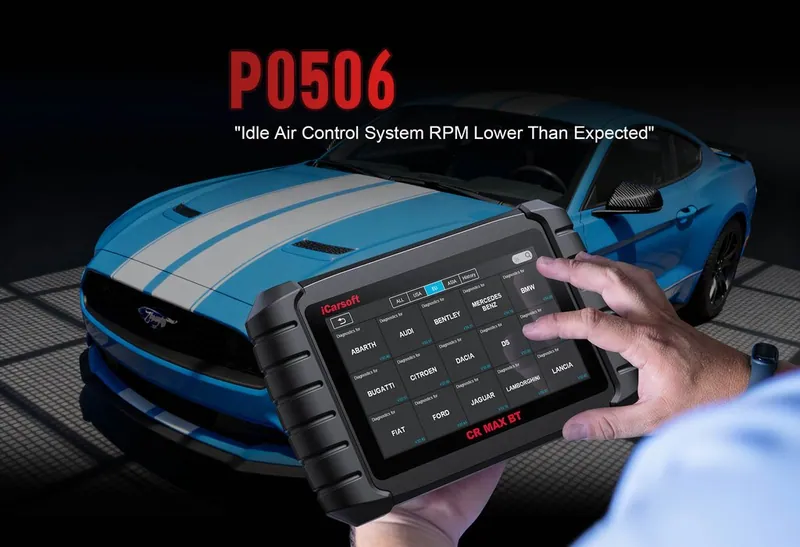
Tap your situation to follow the diagnostic path that matches what you're seeing on this code.
Common Fixes & Costs
- Clean the Throttle Body — Parts: $10-$20, Labor: $100-$200, ~0.8 hr book time (DIY)
- Repair a Vacuum Leak — Parts: $10-$150, Labor: $100-$300, ~1.5 hr book time (Intermediate)
- Replace Idle Air Control (IAC) Valve — Parts: $50-$250, Labor: $100-$300, ~1.2 hr book time (Intermediate)
- Replace Throttle Body Assembly — Parts: $200-$700, Labor: $200-$400, ~1.8 hr book time (Professional)
- Replace Power Steering Pressure Switch — Parts: $30-$100, Labor: $100-$200, ~0.7 hr book time (Intermediate)
DIY vs Professional
- Clean the Throttle Body 🟢 Beginner
Tools: Screwdriver/ratchet set, throttle body cleaner, rags, soft brush. - Repair a Vacuum Leak 🟢 Beginner
Tools: Pliers, screwdriver, new hose. Smoke machine for diagnosis. - Replace Idle Air Control (IAC) Valve 🟢 Beginner
Tools: Screwdriver/ratchet set, new IAC valve and gasket. - Replace Throttle Body Assembly 🟢 Beginner
Tools: Ratchet set, new throttle body and gasket, torque wrench, bidirectional scan tool.
Used vs. New Parts: Buying Guide
When a used part is worth it: For expensive electronic throttle bodies (ETBs), a used part from a low-mileage, accident-damaged vehicle is a cost-effective option for older cars where a new OEM part is cost-prohibitive.
Donor-vehicle mileage cap: roughly under 60000 miles for the part to have meaningful remaining life.
Donor quality checklist:
- Verify the donor vehicle's mileage and ensure it wasn't scrapped for engine-related issues.
- Physically inspect the part for corrosion, damage, or excessive grime in its passages.
- Match the part number exactly, as slight variations lead to incompatibility.
Decision logic:
- If The part is a simple IAC valve and a new aftermarket version is under $100 → Buy new for the warranty and peace of mind.
- If The part is an expensive electronic throttle body ($400+ new) and your vehicle is over 150K miles → A tested, warranted used part is a reasonable choice to save money.
- If The failure is purely electronic (bad sensor/motor) and not from wear/dirt → New or remanufactured is better, as used electronics carry a high risk of failure.
Warranty tradeoff: Used parts from a reputable salvage yard typically offer a 30-90 day warranty. New aftermarket parts come with a 1-year to limited lifetime warranty. New OEM parts offer the best warranty but at the highest cost.
Worst-case if a used part fails: $200-$500 if a used part fails after the warranty period, requiring you to pay for the replacement part and labor again.
What Happens If You Wait — Timeline
- 0-2 weeks: Check Engine Light illuminates. Idle dips slightly (50-100 RPM below normal) when coming to a stop, but rarely stalls. No other major symptoms. (MPG impact: 0-3%% · Added cost: $0)
- 2 weeks - 3 months: Idle becomes noticeably rough and consistently low. Engine stalls once or twice a week, especially on cold starts or with A/C on. Hesitation felt when accelerating. (MPG impact: 3-8%% · Added cost: $25-$75 in wasted fuel)
- 3-6 months: Stalling at stops becomes frequent and a safety concern. The engine runs rough continuously at idle. Inefficient combustion begins to foul spark plugs. (MPG impact: 8-15%% · Added cost: $200-$500 (spark plug replacement and starter/battery stress))
- 6+ months: Chronic low idle and inefficient air-fuel mixture overheats the catalytic converter, leading to total failure. The vehicle is unreliable and stalls in dangerous situations. (MPG impact: 15-25%% · Added cost: $1000-$4000 (catalytic converter replacement))
Cost of Not Fixing It
- Immediate: Stalling in traffic or at intersections poses a significant safety risk. Fuel economy decreases by 5-10% due to inefficient engine operation. (Added cost: Negligible)
- 1-6 months: Persistent low idle causes incomplete combustion, leading to carbon fouling of spark plugs. Frequent stalling and restarting puts severe stress on the battery and starter. (Added cost: $200-$500 (spark plug replacement, starter/battery wear))
- 6+ months: Chronic inefficient combustion contaminates and overheats the catalytic converter, leading to total failure. This turns a minor repair into a major expense. (Added cost: $1000-$4000 (catalytic converter replacement))
Diagnosis Steps
- Check for Other Trouble Codes
Use an OBD-II scanner to check for concurrent codes. Lean codes (P0171, P0174) point to a vacuum leak. IAC codes (P0505) point to an electrical failure. Always diagnose and fix these accompanying codes first.
Tools: OBD-II Scanner (Beginner) - Clean the Throttle Body
This is the most common fix. Remove the air intake tube. Use dedicated throttle body cleaner and a soft brush to remove all carbon buildup from the bore and both sides of the throttle plate. Do not force electronic throttle plates open aggressively.
Tools: Throttle Body Cleaner, Soft Brush, Rags, Screwdriver/Ratchet (Intermediate) - Perform an Idle Relearn Procedure
After cleaning the throttle body, the PCM must relearn the new idle characteristics. Disconnect the battery for 15 minutes, or follow your manufacturer's specific timed key-cycle procedure. Skipping this step guarantees the code will return.
Tools: None or OBD-II Scanner (Beginner) - Visually Inspect the Air Intake System
Check for a severely dirty air filter, cracked air intake ducts, and loose clamps. A collapsed intake boot restricts airflow and triggers the code.
Tools: Flashlight, Basic Hand Tools (Beginner) - Inspect for Vacuum Leaks
Inspect all vacuum hoses connected to the intake manifold for cracks or loose connections. Listen for a hissing sound. Pay close attention to the PCV valve hose. Use a smoke machine for hard-to-find leaks.
Tools: Flashlight, Smoke Machine (optional) (Intermediate) - Clean or Test the Idle Air Control (IAC) Valve
If equipped with a separate IAC valve, remove it and clean its passages and pintle with throttle body cleaner. If cleaning fails, the internal motor is likely dead.
Tools: Screwdriver/Ratchet, Throttle Body Cleaner, Rags (Intermediate) - Analyze Live Sensor Data with a Scan Tool (Pro Tip)
Observe live data at warm idle. Compare 'Target Idle RPM' to 'Actual Engine RPM'; a persistent gap of 100+ RPM confirms the fault. Check 'Mass Airflow (MAF)' (should be 2-5 g/s) and 'Throttle Position Sensor (TPS)' (should be under 1.0V or 1-5%).
Tools: Advanced OBD-II Scan Tool (Advanced) - Test Fuel Pressure and System Voltage (Pro Tip)
Connect a fuel pressure gauge. Idle pressure should be stable at 40-50 PSI. Use a multimeter to check battery voltage with the engine running; it must be between 13.5V and 14.5V to operate electronic throttle components properly.
Tools: Fuel Pressure Gauge, Multimeter (Advanced) - Electrically Test the Idle Air Control (IAC) Valve (Pro Tip)
Test the internal windings of the IAC valve with a multimeter set to Ohms (Ω). Measure resistance between the pins (typically 0.5–2 kΩ). Infinite resistance means an open circuit; zero resistance means a short. Both require replacement.
Tools: Multimeter, Vehicle-Specific Repair Manual (Advanced) - Verify Manufacturer-Specific DTC Set Conditions (Pro Tip)
Some systems require coolant temperature above 106°F, battery voltage over 10V, and barometric pressure above 22.4 in.Hg before the idle monitor will run. Check your service manual to ensure these conditions are met during testing.
Tools: Advanced OBD-II Scan Tool, Technical Service Manual (Advanced)
When This Code Triggers (Freeze-Frame Conditions)
- DTC Trigger: Actual RPM < Target RPM by 100+ (The code sets when the actual engine speed is significantly lower than what the PCM is commanding at idle.)
- Vehicle Speed: 0 mph (The idle monitor runs only when the vehicle is stationary.)
- Throttle Position: 0-5% (The fault is logged when the driver's foot is off the accelerator pedal and the throttle is in its closed or idle position.)
- Engine Coolant Temp: 170-220°F (The monitor typically runs when the engine is at full operating temperature.)
Related Codes
- P0507 — The exact opposite code, meaning "Idle RPM Higher Than Expected". A large vacuum leak or an IAC valve stuck open typically causes P0507.
- P0505 — Indicates a general "Idle Air Control System Malfunction". Seeing this alongside P0506 strongly suggests an electrical circuit problem (bad wiring, faulty IAC motor) rather than just carbon buildup.
- P0171 / P0174 — These "System Too Lean" codes frequently appear with P0506 when a vacuum leak is the root cause. Unmetered air causes the lean condition and drops the idle.
- P0101 / P0106 — Relates to the MAF and MAP sensors. Implausible signals from these sensors prevent the PCM from calculating engine load, leading to improper idle speed control.
Climate & Environmental Factors
- Cold Weather: Low temperatures exacerbate idle problems. The PCM commands a higher idle speed on a cold engine, making physical restrictions (like a dirty throttle body) more apparent and causing cold-start stalling.
- High Altitude: Lower barometric pressure at high altitudes forces the PCM to adjust idle control. Marginal components or minor vacuum leaks prevent the system from compensating correctly, triggering P0506.
- Humidity: High humidity skews the readings of a slightly dirty Mass Airflow (MAF) sensor, leading to incorrect air-fuel calculations and contributing to idle instability.
How to Talk to a Mechanic About This Code
Say this: "I have a P0506 code with a low, stalling idle. I'd like to book a diagnostic appointment. Please start by inspecting and cleaning the throttle body and checking for obvious vacuum leaks before quoting a new throttle body assembly."
This signals you've done your research and know the most common, inexpensive fixes. It directs the mechanic to follow a logical diagnostic path and prevents immediate upselling on expensive parts.
Avoid saying:
- 'My check engine light is on, can you just fix it?' (Invites unnecessary diagnostics or parts).
- 'Just do whatever you think is necessary.' (Gives up all control over the cost).
- 'A friend told me I need a new throttle body.' (Leads a mechanic to skip proper diagnosis and replace a part you may not need).
Questions to ask before authorizing the repair:
- Did you clean the throttle body first, and did it make any difference?
- If you suspect a vacuum leak, how did you test for it? Did you perform a smoke test?
- If the throttle body needs replacement, is an 'idle relearn' procedure required, and is that included in the labor cost?
- Can you show me the old part and explain why it failed?
- What is the warranty on the parts and labor for this specific repair?
Where to Take It: Dealer vs Independent vs Chain
- Dealer:
Best for: Vehicles still under a powertrain or emissions warranty., Repairs involving a known Technical Service Bulletin (TSB) that requires a proprietary PCM software update (reflash).
Downsides: Significantly higher labor rates (1.5-2x) compared to independent shops., May default to replacing an entire throttle body assembly when a simple cleaning would suffice. (Typical cost: +50% vs. baseline) - Independent Shop:
Best fit for most situations. A reputable independent shop handles the vast majority of P0506 causes effectively and at a reasonable price.
Best for: Out-of-warranty vehicles where cost is a primary concern., Diagnosing and fixing the most common causes of P0506, such as throttle body cleaning, IAC valve replacement, and vacuum leak repairs.
Downsides: Shop quality and diagnostic capabilities vary widely. Vet the shop through online reviews and ensure they are ASE certified., May lack the expensive, manufacturer-specific tools to perform a required PCM reflash. (Typical cost: +0% vs. baseline) - Chain Shop:
Use with caution. Acceptable for a straightforward throttle body cleaning if the price is competitive, but be highly skeptical of recommendations for expensive parts.
Best for: Simple, clear-cut jobs like a pre-quoted throttle body cleaning.
Downsides: Technician skill varies dramatically from one location to another., High pressure to upsell, potentially leading to a recommendation for a full throttle body replacement ($500+) when only a cleaning ($150) was needed. (Typical cost: -10% vs. baseline)
When to Walk Away From the Repair
If the estimated repair cost exceeds 40-50% of your car's private-party value, seriously consider selling or trading in the vehicle instead of repairing it.
- Car worth $4000, fix is $1800: Walk away. The repair cost is 45% of the car's value. It's not financially sound to invest this much into an older vehicle.
- Car worth $12000, fix is $900: Fix it. The repair cost is less than 10% of the car's value, which is a reasonable investment to keep a valuable car running well.
- Car worth $2500, fix is $200: Fix it. A simple throttle body cleaning or vacuum hose replacement is a small price to pay to keep the car operational and safe.
What Scan Tool You Need for This Code
Minimum: A code reader that displays live data, specifically Engine RPM (Actual vs. Target) and Throttle Position.
A basic $20 code reader only shows the 'P0506' code. It won't show the live data needed to see *why* the idle is low (e.g., is the computer commanding a low idle, or is it trying to raise it but failing?). Live data distinguishes between a sensor issue and a physical restriction.
Budget: BlueDriver Pro (~$100) — Connects to your smartphone via Bluetooth to graph live data like RPM and throttle position. It provides freeze-frame data to see engine conditions when the code was set.
Mid-range: XTOOL D7 or Foxwell NT510 Elite (~$150-350) — These bidirectional scanners command an 'Idle Relearn' or 'Throttle Body Relearn' procedure, which is mandatory on many modern cars after cleaning the throttle body.
Professional: Autel MaxiCOM MK808Z (~$400-500) — Offers full bidirectional control to perform throttle relearn procedures and allows you to command the IAC valve or throttle body to specific positions to test its function directly.
Rent vs buy: For a one-time code read, use the free 'Loan-A-Tool' program from stores like AutoZone. Buy a scanner only if you need advanced functions like an idle relearn or plan to perform your own diagnostics regularly.
How to Clear the Code After You Fix It
- Use an OBD-II scan tool to clear the P0506 code from the PCM's memory.
- Perform the manufacturer-specific Idle Relearn Procedure.
- Complete a full OBD-II drive cycle to allow readiness monitors to run and confirm the fix.
Drive cycle (~30 minutes): A general drive cycle includes: a cold start (engine off for 8+ hours), 2-3 minutes of idling, 10-15 minutes of mixed city/highway driving (including steady speeds around 55 mph), and several stop-and-go periods.
Readiness monitors affected: Idle Control System Monitor, Catalyst Monitor, Evaporative System (EVAP) Monitor, O2 Sensor Monitor
Before emissions retest: drive at least 50 miles to fully set monitors.
Watch out for:
- Disconnecting the battery resets all readiness monitors, making it impossible to pass an emissions test immediately.
- The code returns if the underlying mechanical or electrical fault is not corrected.
- Failure to perform a required idle relearn procedure after cleaning parts guarantees the fix will fail.
Will This Fail Emissions / State Inspection?
Yes — this code typically fails an OBD-II emissions inspection.
- California: An illuminated Check Engine Light is an automatic failure of the smog inspection. The vehicle cannot be registered until the issue is fixed and the code is cleared.
- New York: A vehicle with an active Check Engine Light automatically fails the emissions portion of the annual NYS inspection.
- Texas: In counties requiring emissions testing, an illuminated Check Engine Light is an automatic failure.
Most Commonly Affected Vehicles
- Ford F-150, Explorer, Mustang (2004-2008) — Highly prone to P0506 after a battery disconnect. TSBs indicate sludge in the electronic throttle body is the cause. Fix involves thorough cleaning and a PCM reprogram to a newer calibration.
- Chevrolet Cruze, Silverado, Suburban (2007-2021) — On the 2011-2016 1.4L Cruze, this code is almost always a vacuum leak from a failed PCV diaphragm built into the valve cover. The entire cover must be replaced.
- Honda Accord, Civic, Element (2003-2012) — Commonly caused by a dirty throttle body or a carbon-stuck Idle Air Control (IAC) valve. An idle relearn is critical after service.
- Nissan Altima, Sentra, Xterra (2002-2012) — Issues almost always point to a dirty electronic throttle body. A multi-step, precisely-timed 'Idle Air Volume Relearn' procedure is mandatory after cleaning.
- Chrysler/Dodge 300, Charger, Ram (2005-2014) — The electronic throttle body on these Hemi and V6 vehicles becomes dirty or fails electronically, leading to idle control issues.
- Hyundai Elantra, Sonata (2007-2015) — Frequently caused by a dirty throttle body or a failing Idle Air Control (IAC) valve. Cleaning both components is the most effective first step.
- Subaru Outback, Forester, Impreza (2005-2014) — Often related to a dirty throttle body or a vacuum leak from a cracked PCV hose. The code frequently appears after disconnecting the battery.
- Toyota Camry, Corolla (2002-2011) — Susceptible to carbon buildup on the throttle body and within the Idle Air Control (IAC) valve passages.
Manufacturer-Specific Notes
- Ford: Disconnecting the battery triggers P0506 by erasing the PCM's learned adaptations for a dirty throttle body. Ford issued Customer Satisfaction Program 13N03, extending the throttle body warranty to 10 years/150,000 miles for specific 2009-2013 models.
- General Motors (GM): On 1.4L Turbo engines, the PCV system is integrated into the valve cover. A failed internal diaphragm creates a massive vacuum leak, causing P0506. The entire valve cover must be replaced.
- Nissan: An 'Idle Air Volume Relearn' is mandatory after cleaning the throttle body or disconnecting the battery. It is a complex, timed procedure involving specific key cycles and pedal presses. Skipping it prevents the code from clearing.
- Subaru: P0506 frequently triggers after a battery disconnect because the computer loses its learned idle values. Performing an idle relearn procedure (idling to warm up, then idling with A/C on) resolves the code after a throttle body cleaning.
Real Owner Stories
2006 Chevy Trailblazer 4.2L - The Easy Fix
Check Engine Light came on with code P0506, but no major driveability issues were noticed. The owner suspected a dirty throttle body.
What they tried:
- Removed and thoroughly cleaned the throttle body, which had significant carbon buildup.
- Replaced the throttle body gasket and air filter.
- Reset the PCM's learned adjustments by pulling specific PCM fuses (#10 and #28) for 30 minutes instead of disconnecting the battery, avoiding HVAC actuator resets.
Outcome: After reassembly and a specific idle relearn procedure, the Check Engine Light cleared and the truck drove smoothly.
Lesson: A thorough throttle body cleaning is often the complete fix. Pulling specific PCM fuses is a safer way to reset engine adaptations than disconnecting the battery on certain GM vehicles.
2004 Ford F-150 - The Misdiagnosis Trap
Check Engine Light with P0506 appeared immediately after replacing the battery. The truck had a very low, rough idle and stalled frequently.
What they tried:
- Initial thought was a loose connector bumped during the battery change.
- A forum search revealed this is a common issue on Fords after power loss, as the PCM's memory of compensating for a dirty throttle body is erased.
Outcome: The confirmed fix was removing and cleaning the throttle body. In some cases, a PCM reprogram (reflash) from a dealer is required per a Technical Service Bulletin.
Lesson: If P0506 appears on a Ford right after a battery change, the root cause is almost always a dirty throttle body that was previously being compensated for by the PCM's learned memory.
2006 Nissan Altima - The Relearn Nightmare
Vehicle had a hard start and rough idle, eventually throwing code P0506. The throttle body was severely dirty.
What they tried:
- Cleaned the throttle body and MAF sensor, and replaced the air filter.
- After reassembly, the idle was still incorrect. Attempted the complex, multi-step Nissan 'Idle Air Volume Relearn' procedure.
- The manual relearn procedure failed multiple times due to incorrect timing of key cycles and pedal presses.
Outcome: The owner succeeded by carefully following a video guide showing the specific Check Engine Light flashes that indicate the relearn has been accepted, saving a $100+ trip to the dealership.
Lesson: On Nissan vehicles, the 'Idle Air Volume Relearn' procedure is mandatory and notoriously difficult to perform manually. The timing must be exact, or the repair will appear to have failed.
2006 Mazda Tribute 2.3L - The Compound Problem
At 180,000km, the vehicle threw code P0506. The idle dropped from 900 to 700 RPM when the A/C was turned on.
What they tried:
- Cleaned a dirty throttle body and replaced an old air filter.
- Discovered a crack in the flexible air intake hose between the air filter box and the throttle body.
- Sealed the crack with duct tape as a temporary test.
Outcome: With the cracked hose sealed and the throttle body clean, the idle became steady at 900 RPM even with the A/C on, and the fault code cleared.
Lesson: P0506 is often caused by multiple issues at once, like a dirty throttle body AND a vacuum leak. Always inspect the entire air intake path for cracks.
How to Prevent This Code From Triggering
- Clean the throttle body periodically (Every 30,000 to 50,000 miles) — Prevents the buildup of carbon and oil sludge that physically restricts the throttle plate, which is the number one cause of P0506.
- Use Top Tier certified gasoline (Every fill-up) — These fuels contain a higher concentration of detergents that keep the entire fuel system and throttle body area free from carbon deposits.
- Perform an 'Italian Tune-up' (Once a month) — Driving the car at higher RPMs (3,000-4,000 RPM) for a sustained period on the highway helps the engine reach optimal temperature and burn off light carbon deposits.
- Inspect and/or replace the PCV valve (Inspect every 30,000 miles, replace every 50,000-60,000 miles) — A functioning PCV system properly vents crankcase gases. A clogged valve leads to pressure changes and oil contamination that fouls the throttle body.
- Change the engine air filter regularly (Every 15,000-30,000 miles) — A clean air filter ensures unrestricted airflow and prevents dirt from contaminating the MAF sensor and throttle body.
Frequently Asked Questions
Can I fix P0506 myself?
Yes. The most common cause is a dirty throttle body, which is a straightforward cleaning job for a DIYer with basic tools and a $10 can of cleaner. Repairing a cracked vacuum hose is also a common, accessible DIY fix.
Will cleaning the throttle body always fix P0506?
Not always, but it fixes the issue in a high percentage of cases and is the most cost-effective first step. If cleaning fails, check for vacuum leaks or a failed Idle Air Control (IAC) valve.
What's a common misdiagnosis for P0506?
A common mistake is replacing the expensive electronic throttle body without first performing a thorough cleaning. Another major pitfall is failing to perform the vehicle-specific idle relearn procedure after the repair, causing the code to return immediately.
My car showed P0506 right after I changed the battery. Why?
Disconnecting the battery erases the computer's memory. If your throttle body was slightly dirty, the computer had learned to compensate for it over time. With its memory erased, it reverts to factory settings and can no longer control the idle properly, revealing the need for a cleaning.
How much does it cost to have a shop fix P0506?
A professional repair ranges from $150 to over $900. A simple throttle body cleaning costs $150-$250, while diagnosing a hidden vacuum leak adds $100-$150 for a smoke test. Replacing a failed electronic throttle body costs $500-$1,000.
Can a bad gas cap cause P0506?
No. A loose gas cap affects the evaporative emissions (EVAP) system and triggers codes like P0455 or P0457. P0506 strictly relates to the engine's air intake system at idle.
What's the difference between P0506 and P0507?
They are opposites. P0506 means the idle is too low, typically caused by a dirty throttle body or sticking IAC valve. P0507 means the idle is too high, usually caused by a large vacuum leak or an IAC valve stuck open.
My P0506 code came back after cleaning the throttle body. Now what?
If the code returns, you likely missed a vacuum leak, didn't clean the throttle body thoroughly, or failed to perform the idle relearn procedure. Research your vehicle's specific relearn steps. If that fails, perform a smoke test to locate hidden vacuum leaks.
Can a bad MAF sensor cause P0506?
Yes. If the Mass Airflow (MAF) sensor is dirty, it under-reports the amount of air entering the engine. The computer then fails to command the throttle or IAC valve to open enough, dropping the idle speed and triggering P0506.
Key Takeaways
- Clean the throttle body and its plate with a $10 dedicated cleaner as your first diagnostic step, as carbon buildup causes over 70% of P0506 codes.
- Perform your vehicle's specific electronic idle relearn procedure immediately after cleaning or replacing any intake parts, or the P0506 code will return.
- Inspect for vacuum leaks if you also have P0171 or P0174 (System Lean) codes, as unmetered air disrupts the air-fuel ratio and drops idle speed.
- Stop driving and fix the vehicle within 7 days if the engine stalls at traffic lights, as chronic low idle damages the catalytic converter and risks a $1,500+ replacement.
Helpful Videos

Shop the Parts Behind P0506
Below are the parts most often responsible for code P0506, ranked by how frequently each one is the actual culprit (per the diagnosis above). Tap any to see what we have for your vehicle.



The information in this article is provided for general reference and educational purposes only. Vehicle specifications, procedures, and part compatibility can vary by production date, trim level, and region. Always consult your vehicle's factory service manual and verify part numbers before purchasing or performing repairs. Safety-critical components such as airbags, seat belts, and braking systems should be installed by a qualified professional.
- 🧭 Diagnostic Flowchart
- 🎬 Helpful Videos
- 🛍️ Shop This Part
- What Does P0506 Mean?
- Can I Drive With P0506?
- Common Causes
- Symptoms
- Common Fixes & Costs
- DIY vs Professional
- Used vs. New Parts: Buying Guide
- What Happens If You Wait — Timeline
- Cost of Not Fixing It
- Diagnosis Steps
- When This Code Triggers (Freeze-Frame Conditions)
- Related Codes
- Climate & Environmental Factors
- How to Talk to a Mechanic About This Code
- Where to Take It: Dealer vs Independent vs Chain
- When to Walk Away From the Repair
- What Scan Tool You Need for This Code
- How to Clear the Code After You Fix It
- Will This Fail Emissions / State Inspection?
- Most Commonly Affected Vehicles
- Manufacturer-Specific Notes
- Real Owner Stories
- 2006 Chevy Trailblazer 4.2L - The Easy Fix
- 2004 Ford F-150 - The Misdiagnosis Trap
- 2006 Nissan Altima - The Relearn Nightmare
- 2006 Mazda Tribute 2.3L - The Compound Problem
- How to Prevent This Code From Triggering
- Frequently Asked Questions
- Can I fix P0506 myself?
- Will cleaning the throttle body always fix P0506?
- What's a common misdiagnosis for P0506?
- My car showed P0506 right after I changed the battery. Why?
- How much does it cost to have a shop fix P0506?
- Can a bad gas cap cause P0506?
- What's the difference between P0506 and P0507?
- My P0506 code came back after cleaning the throttle body. Now what?
- Can a bad MAF sensor cause P0506?
- Key Takeaways